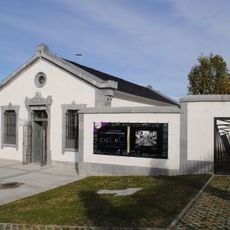
Camposagrado Palace, Baroque palace in Avilés, Spain
Camposagrado Palace is a Baroque palace in Avilés with two main facades. The north one, facing Pier Park, was built against the old city wall and has three floors: small arrow slits below, ten segmental arches on Tuscan columns with a stone parapet above, and a third floor added in the 19th century. The south facade, facing Plaza de Camposagrado, was designed by Francisco Menéndez Camina between 1693 and 1696, with two square towers and the family coat of arms over the central balcony. It now houses the Art School of the Principality of Asturias.
The palace was probably designed by Avilés architect Francisco Menéndez Camina between 1693 and 1696, built on medieval remains of a previous palace owned by the Las Alas family. In 1661 Gutierre Bernaldo de Quirós received the title Marquis of Camposagrado, and his wife Eulalia de las Alas Carreño passed the property to her heirs. In the 19th century it served as a military barracks during the Peninsular War, and after restoration by the City Council it became the School of Art.
The palace takes its name from the title of Marquis of Camposagrado, granted in 1661 to Gutierre Bernaldo de Quirós, whose wife Eulalia de las Alas Carreño brought the Las Alas family property. The southern facade displays the family coat of arms above the central balcony, and the northern loggia was built so residents could watch the port.
The palace houses the Escuela Superior de Arte del Principado de Asturias, so access is tied to the school's calendar. The grand stone staircase is the only interior element preserved after the building was converted into flats and shops; the rest of the interior was destroyed and later restored. Visitors should check term dates and opening conditions with the school before planning a look inside.
The north facade toward Pier Park keeps a defensive look: its lower floor is pierced by small arrow slits and the middle floor has ten segmental arches on Tuscan columns. It once met the town wall directly on the ría, and the third storey was added later, probably in the 19th century.
The community of curious travelers
AroundUs brings together thousands of curated places, local tips, and hidden gems, enriched daily by 93,648 contributors worldwide.