Silla de Felipe II, carved granite outcrop in San Lorenzo de El Escorial, Spain
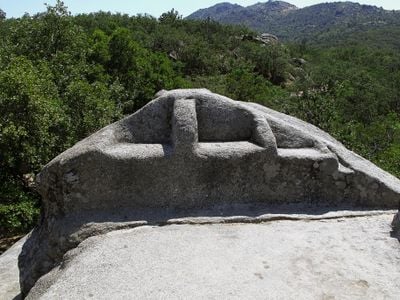
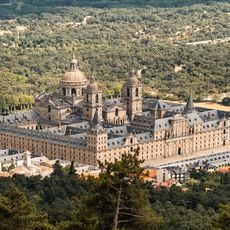
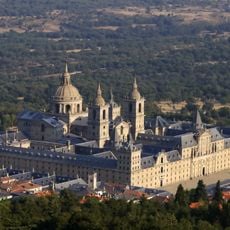
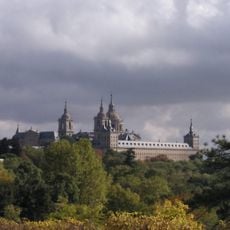
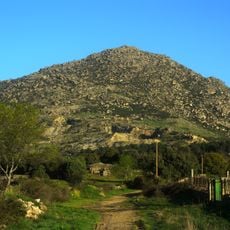
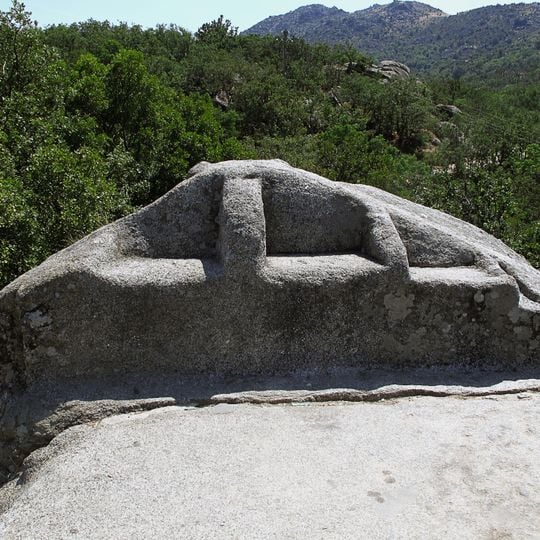
Silla de Felipe II is a set of stepped platforms and seats cut directly into a granite outcrop known as Canto Gordo, on the northern slope of the Machota Alta at the foot of Las Machotas. The main unit faces north toward the El Escorial monastery and holds three stone seats divided by two armrests; two further units are plain platforms reached by steps carved in the rock. The pale grey granite is rough and stained with lichen.
Tradition holds that Philip II used these granite platforms and seats to watch the Monastery of El Escorial being built between 1563 and 1584. In 1999 Alicia M. Canto of the Universidad Autónoma de Madrid argued instead for a pre-Roman Vetton altar, possibly for ritual animal sacrifice, a view supported in 2015 by the find of an anthropomorphic figure and smaller altars nearby. A third hypothesis dates the carving to a 19th-century historicist recreation.
The name comes from a tradition, not a documented fact: Philip II is said to have watched the monastery works (1563–1584) from here. Alicia M. Canto's 1999 hypothesis instead links the carved platforms to a pre-Roman Vetton altar, and in 2015 an anthropomorphic figure and smaller altars were found nearby. Luis Álvarez Catalá's 1890 painting of the site appeared on 100-peseta banknotes from 1925 to 1939.
The site is accessible via a marked hiking trail from the La Herrería car park, which provides a clear route to the location. The area is exposed and subject to windy conditions, so wear weather-appropriate clothing.
In 1890 Luis Álvarez Catalá painted La silla de Felipe II en El Escorial, a work that won the first medal at the Premio Nacional de Bellas Artes and gold in Berlin in 1891. The painting illustrated the back of Spain's 100-peseta banknotes from July 1925 to April 1939.
The community of curious travelers
AroundUs brings together thousands of curated places, local tips, and hidden gems, enriched daily by 94,176 contributors worldwide.