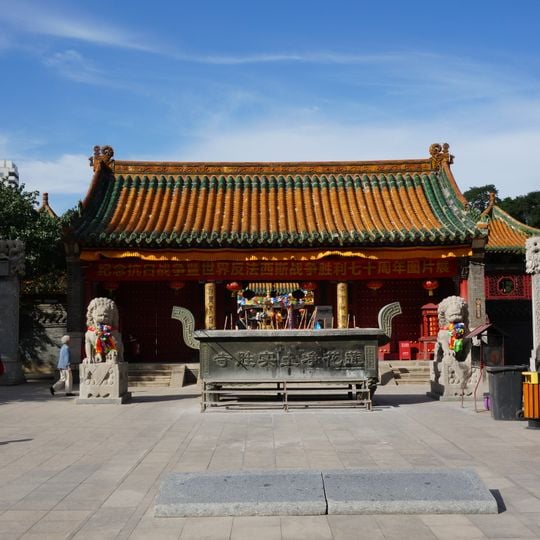
実勝寺, Buddhist temple in Shenhe District, Shenyang, China.
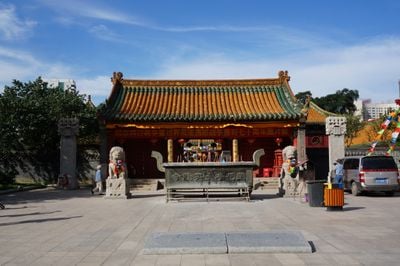
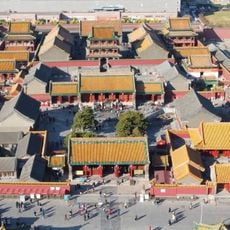
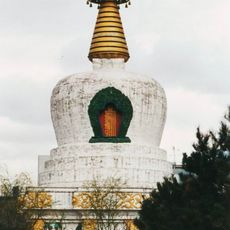
Shisheng Temple, also known as Huang Temple, occupies a rectangular walled compound of over 7,000 square metres in Heping District. It faces south and is divided into two courtyards: along the central axis stand the mountain gate, the Heavenly Kings Hall and the main hall, with bell and drum towers, side halls and the two-storey Mahakala Buddha Tower flanking them. The main hall, raised on a blue-brick platform, has 24 red columns and a roof of yellow glazed tiles with green edging.
In 1635 the Mongol lama Mergen Dorji brought the Mahakala golden statue to Shengjing on a white camel, which knelt and died at a spot west of the city; a shrine was built there that year. In 1636 Hong Taiji ordered it expanded into the Lotus Pure Land Shisheng Temple, completed on 8 September 1638. The Qing court repaired it in 1726 and Emperors on eastern tours, including Qianlong four times, worshipped here.
The halls contain statues of important Buddhist figures that show what people venerate here today. Visitors can observe how the spaces are used for daily prayers and religious ceremonies.
The temple stands at 206 Huangsi Road in Heping District, its gate facing south; the two courtyards are entered in sequence along a central axis. The bell tower and drum tower flank the entrance, and the Mahakala Buddha Hall lies southwest of the main hall. The annual Buddha-lifting festival takes place on the 15th to 17th days of the fourth lunar month.
The Mahakala Buddha Hall once held a 64.5-jin gilt statue, cast in the Yuan era and carried to Shenyang on a white camel. It was stolen on 20 March 1946 and never recovered; a clay image made in 1990 was replaced by a newly cast gilded figure in 2016. The hall's stairway was fitted with two locks and a trapdoor against theft.
The community of curious travelers
AroundUs brings together thousands of curated places, local tips, and hidden gems, enriched daily by 93,091 contributors worldwide.