Igel Column, Roman funerary monument in Igel, Germany.
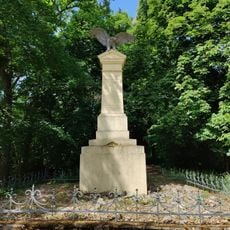
The Igel Column is a Roman funerary monument of red sandstone, about 23 metres high, with a four-stepped base, a low podium, a projecting cornice, and a storey framed by flat Corinthian pilasters. Its reliefs show the cloth merchant Secundinii family, a procession of six coloni bringing donations, and mythological scenes. The top is crowned by a heavily weathered eagle sculpture.
The column was erected in the 3rd century AD by the brothers Lucius Secundinius Aventinus and Lucius Secundinius Securus, cloth merchants of the Secundinii family. Its dating is debated: some scholars place it around 200–215, others in the second third of the century. No burial was found nearby, so it may have served as a cenotaph while the family graves lay on private land. The monument also advertised the family's cloth trade.
The name Igel is traditionally traced to the Latin aquila, eagle, after the bird carved on the column's top. The reliefs show the Secundinii family's cloth trade and a procession of six coloni bringing a hare, two fish, a kid, an eel, a rooster and a basket of fruit to their master's house.
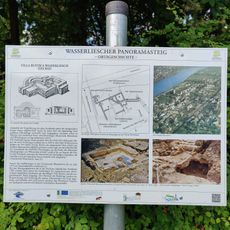
The column stands in the open on Trierer Straße in Igel, freely accessible at any time. A garden on the opposite slope, the Säulengarten, has information panels and a view of the monument. The site is a protected cultural property marked with the blue-and-white Hague Convention emblem.
The medieval belief that the south face showed the marriage of Constantius Chlorus and Saint Helena, mother of Constantine, saved the column from destruction after the Roman era. The name Igel is traditionally traced to the Latin aquila, eagle, after the bird once carved on top.
The community of curious travelers
AroundUs brings together thousands of curated places, local tips, and hidden gems, enriched daily by 93,117 contributors worldwide.