Rathaus, Cultural heritage monument in Market Square, Heidelberg, Germany
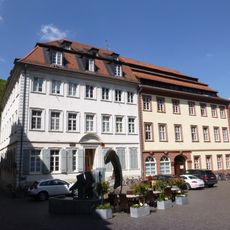
Heidelberg's Rathaus is a Baroque building on the Marktplatz, erected from 1701 to 1703 after the city's destruction in 1689. Its front facade carries masks and the electoral coat of arms carved by the Hungarian sculptor Heinrich Charrasky. A north wing in Neo-Renaissance style was added between 1886 and 1890, and a Neo-Baroque south wing followed between 1911 and 1924.
The building was established as the administrative heart of Heidelberg and served the Palatinate as a center of political governance. Over centuries it shaped the city's development as a seat of official administration and local decision-making.
The building remains a gathering place where residents connect with local government and participate in city events throughout the year. Its ornate stone facade reflects the importance placed on civic life in Heidelberg's community.
The main facade faces the Market Square, where the Christmas market is officially opened each year from the balcony by a Christkind. During the market, the facade is illuminated with Christmas motifs from the square, turning pink on Pink Monday after the first Advent. The tower added beside the main facade was later removed, and its lower storeys were integrated into the facade.
From the facade of the City Hall one can directly see Heidelberg Castle and the Neckar River, linking the administrative space with the natural landscape. This sight line makes the square a vantage point where the entire historical importance of the city becomes apparent.
The community of curious travelers
AroundUs brings together thousands of curated places, local tips, and hidden gems, enriched daily by 93,507 contributors worldwide.