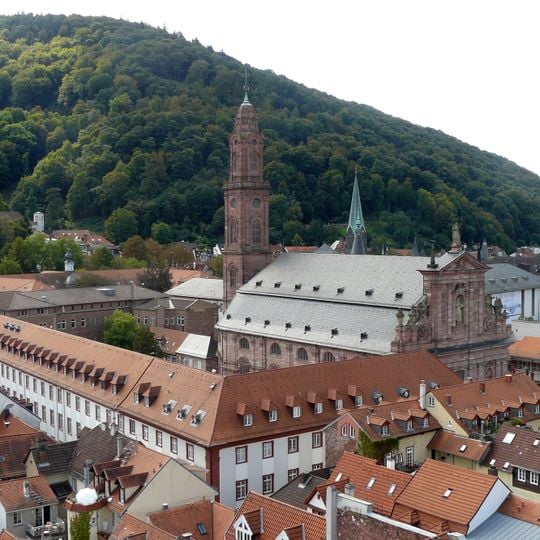
Jesuitenkirche, Catholic church building in University Square, Heidelberg, Germany
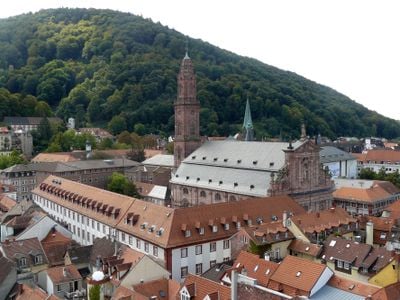
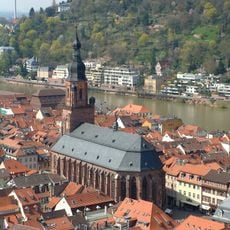
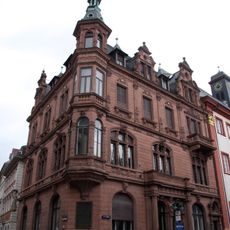
The Jesuitenkirche is a Baroque church near University Square in Heidelberg's old town, built from 1712 to 1759 and oriented to the south rather than the usual east. Its pale reddish-brown square tower, added 1868–1872, carries arched openings, clock faces and a small dome with a cross. The reddish-brown stone facade has a triangular pediment with statues at its corners and above the entrance; the broad grey roof is set with many small dormer windows above arched and circular windows. Inside, a long brown tiled floor runs between dark wooden pews, white walls and vaults rest on pillars with gilded capitals, two glass chandeliers hang from the ceiling, and a raised wooden pulpit stands on the right wall.
The foundation stone was laid on 19 April 1712, the birthday of Elector Johann Wilhelm, and Rome approved the design that June. Johann Adam Breunig built the choir and nave on the model of St. Martin in Bamberg, but work stopped in 1717 when his successor Carl Philipp favoured Mannheim. Court architect Franz Wilhelm Rabaliatti completed the church from 1749 to 1759; the neo-baroque tower followed in 1868–1872.
The church is the main Roman Catholic parish of Heidelberg's old town, serving the Heilig-Geist congregation since Grand Duke Karl Friedrich granted it as a parish church on 1 November 1809. Its official name is Pfarrkirche Heiliger Geist und St. Ignatius. A museum of sacred art and liturgy with a treasury is attached, displaying saint figures, chalices, monstrances and vestments from past centuries.
The church is not oriented east as usual but faces south, so the entrance front and tower stand toward the south. It lies in the old town near University Square, close to the Heiliggeistkirche. The Museum für sakrale Kunst und Liturgie with its treasury is attached to the church.
The church is not oriented east as usual but faces south, which the sources call an unusual feature of the building. Its neo-baroque tower was added only in 1868–1872, more than a century after the 1759 completion of the baroque nave. A museum of sacred art and liturgy with a treasury is attached to the church, displaying saint figures, chalices, monstrances and vestments from past centuries.
The community of curious travelers
AroundUs brings together thousands of curated places, local tips, and hidden gems, enriched daily by 92,854 contributors worldwide.