Old Bridge, Stone arch bridge in Heidelberg, Germany
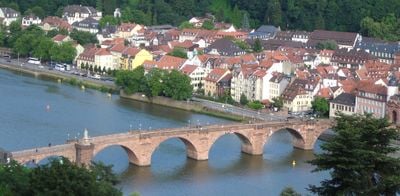
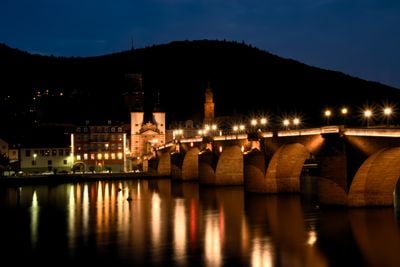
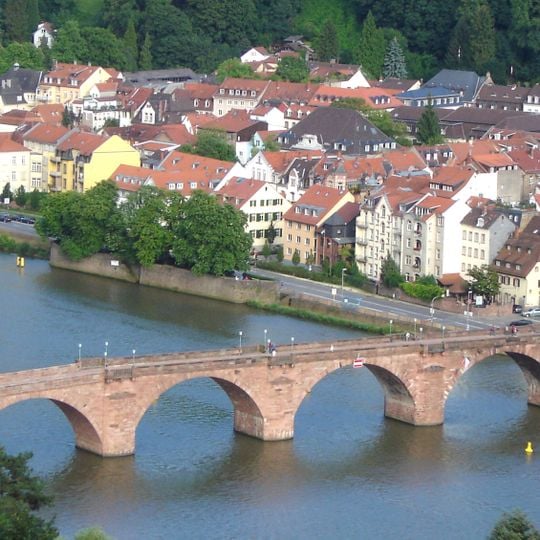
The Old Bridge, or Karl-Theodor-Brücke, is a red sandstone arch bridge over the Neckar in Heidelberg, with a flat deck and a low stone parapet. Its rounded arches rest on thick piers, and at the southern end two white square towers with dark domed roofs flank a gateway. A fifth partial arch continues at the far right, and a small sign is mounted on the parapet.
The ninth bridge at this site was completed in 1788 under Elector Karl Theodor, built of regional red sandstone on the foundations of eight predecessors, most of them wooden, that ice floes and wars had destroyed since the first documented crossing of 1284. On 29 March 1945 German troops blew up three arches and two piers, which were restored after World War II.
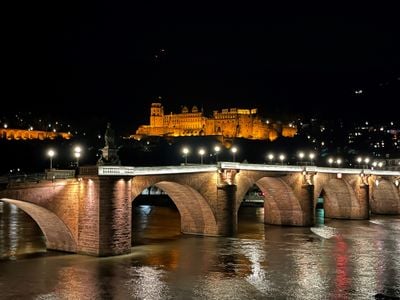
The bridge's nickname dates from 1877, when a second crossing, the Friedrichsbrücke, was built to the west. The bronze monkey statue by Gernot Rumpf, erected in 1979, holds a mirror and makes the sign of the horns; a 1632 poem by Martin Zeiler is inscribed below. Visitors touch the mirror for luck and the nearby bronze mice for fertility.
The bridge links the Old Town with the eastern end of Neuenheim. Pedestrians and cyclists may cross at any time; motor vehicles of residents are allowed only on weekdays before 11:00 and after 16:00. A permanent construction site for renovating the pillar foundations currently narrows the roadway.
The bridge monkey statue, recreated by Gernot Rumpf in 1979, holds a mirror and makes the sign of the horns; the original vanished in the Nine Years' War. Below it, Martin Zeiler's 1632 poem asks passers-by why they stare. Visitors put their heads inside the hollow head and rub the mirror for luck or the bronze mice for fertility.
The community of curious travelers
AroundUs brings together thousands of curated places, local tips, and hidden gems, enriched daily by 92,783 contributors worldwide.