Bederkesaer Roland, Roland statue in Bad Bederkesa, Germany
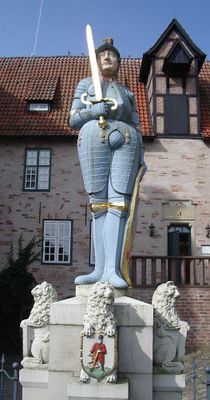
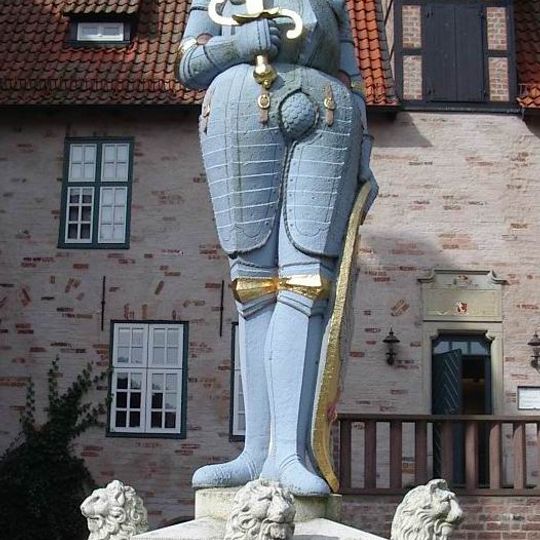
The Bederkesaer Roland is a 1.90-metre sandstone figure of a knight in turquoise late-Renaissance armour, wearing a visorless, feathered helmet. His right hand holds a drawn sword, his left a shield resting on the ground that bears the double-headed imperial eagle. The statue stands on a 1.45-metre pedestal in front of Bederkesa Castle.
This statue was created between 1599 and 1604, possibly by Bremen sculptor Lüder von Bentheim, and first appeared in written records in 1736. Since then it has undergone several relocations within and around Bederkesa Castle, reflecting the place's long history as a symbol of authority.
The shield bears the double-headed imperial eagle, while each of the four sides of the pedestal shows a lion holding a coat of arms: the city of Bremen and the Bremen councillors and Bederkesa drosts Schütte, Kreffting and Schorhar, who probably commissioned the statue. The figure thus marked Bremen's jurisdiction over the Amt Bederkesa.
The statue stands in the courtyard of Bederkesa Castle, where it was returned in 1982 and enclosed by a wrought-iron protective grille. It can be viewed from the surrounding area without entering the castle. Look for the grille, which marks the spot.
The sword was destroyed in 1945 by Canadian soldiers and repaired in 1953, the year the figure was moved to the market square. In 1982, after another repair, it returned to the castle and received a wrought-iron protective grille.
The community of curious travelers
AroundUs brings together thousands of curated places, local tips, and hidden gems, enriched daily by 93,721 contributors worldwide.