Beilstein, Mountain summit in Spessart region, Germany
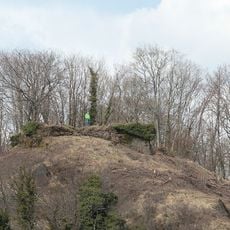
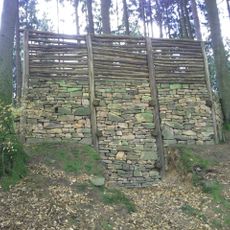
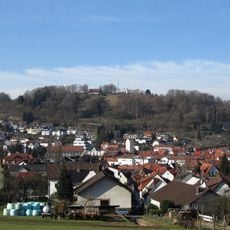
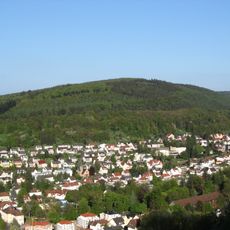
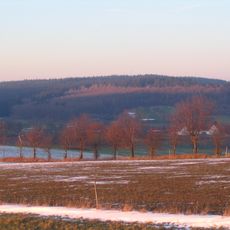
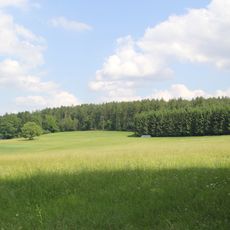
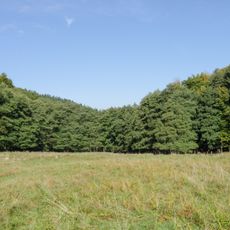
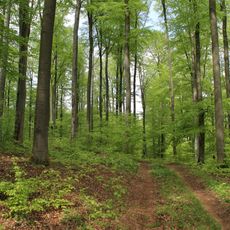
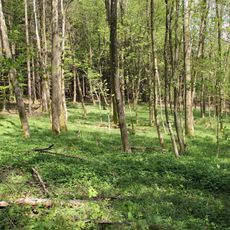
Beilstein is a 499.5-metre basalt cone in the Hessian Spessart, in the municipality of Jossgrund between Lettgenbrunn and Bad Orb. Its upper slopes are wooded, but the summit exposes basalt columns and small spherical formations, and contains the largest basalt cave in the Main-Kinzig district. A 12-metre stretch of wall is all that remains of the medieval hill castle.
The Beilstein is first recorded in 1059 as Bilstein, then a boundary landmark of Fulda monastery rather than a castle. In 1313 the Electorate of Mainz bought the castle and the Lettgenbrunn area from the lords of Hohenlohe-Brauneck; the castle is last mentioned in 1427. Built to guard Mainz property and overlook the Eselsweg trade route, it survives only as a wall foundation about 12 metres long.
The Beilstein is a stop on the Perlen der Jossa, a roughly 25 km cycling route through the Jossgrund created to promote tourism in the Spessart. A local legend tells of a young man who entered the mountain's hidden rock castle with a blue wonderflower, gathered gold and jewels, and lost everything because he forgot the flower on his staff. Local historians link the wonderflower to the Pechnelke, which still grows on the warm basalt.
Several marked hiking trails lead to the summit from different starting points, with the main route beginning at a parking area near the forest edge. Visitors should prepare for changing weather conditions and wear sturdy footwear, as the ground can be uneven.
The basalt here broke through Buntsandstein roughly 200 million years older, and the rock walls show the basalt columns plus small spherical forms. The largest basalt cave in the Main-Kinzig district lies in the hill and serves as a winter roost for several bat species.
The community of curious travelers
AroundUs brings together thousands of curated places, local tips, and hidden gems, enriched daily by 93,310 contributors worldwide.