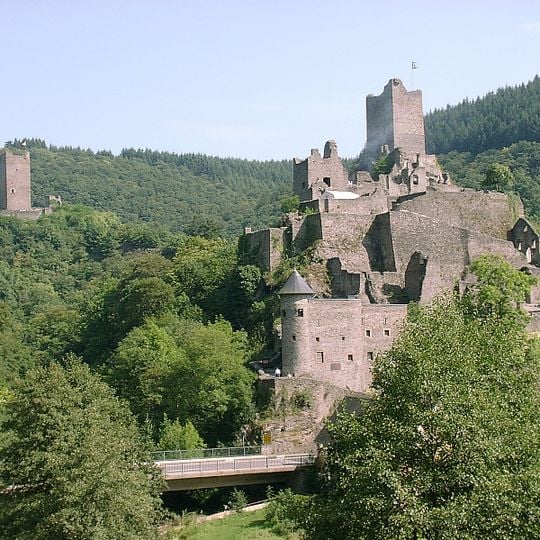
Castles of Manderscheid, Medieval castle ruins in Manderscheid, Germany.
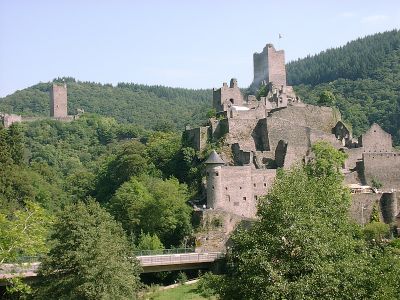
The Castles of Manderscheid are two separate ruins above the Lieser valley: the Oberburg on a levelled hilltop and the Niederburg on a rock below, separated by the river. The Oberburg has a triangular outer wall and a five-storey bergfried, now accessible again, with views over the Niederburg, the town and the valley.
The Manderscheid castles are first documented in the 1141–1146 feud between Count Henry the Blind of Namur-Luxembourg and Archbishop Albero of Trier over St. Maximin's Abbey; the free lords of Manderscheid appear in 1142 as witnesses. The Oberburg belonged to the Electorate of Trier and was destroyed by French troops in 1673. The Niederburg was the seat of the lords of Manderscheid, withstood a siege by Elector Baldwin in 1346–1348, and passed to the Manderscheid-Blankenheim line in 1457.
The name Manderscheid first appears in a 973 deed of gift by Otto II to the Archbishop of Trier, but the castles themselves are recorded only from the feud over St. Maximin's Abbey (1141–1146). The Niederburg was the seat of the lords of Manderscheid, who ruled as advocates of Echternach Abbey; after 1457 the line split into Kail, Schleiden and Blankenheim branches. On the last August weekend a medieval festival on the castle and jousting field draws about 15,000 visitors.
The best way to reach both ruins is on foot using hiking trails that start from Manderscheid and lead to the mountaintops. The paths are open year-round, but summer months offer better conditions and possibly guided visits at the ruins themselves.
The Niederburg was besieged from 1346 to 1348 by troops of Elector Baldwin of Trier but was never taken. The Oberburg, by contrast, was destroyed by French troops in 1673. The two ruins thus preserve opposite outcomes of the same Trier-Luxembourg rivalry.
The community of curious travelers
AroundUs brings together thousands of curated places, local tips, and hidden gems, enriched daily by 94,188 contributors worldwide.