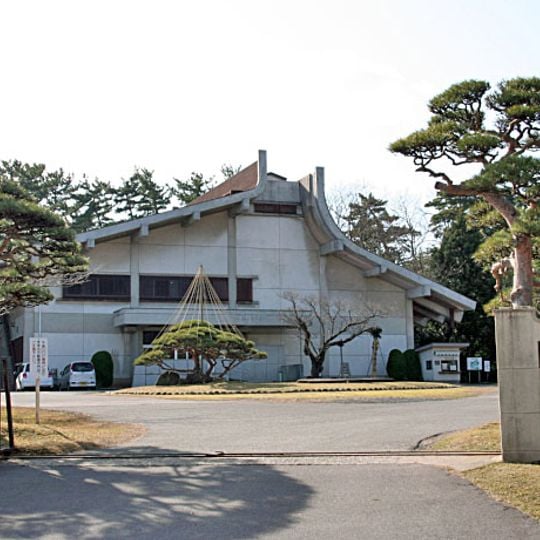
Homma Museum of Art, Art museum in Sakata, Japan
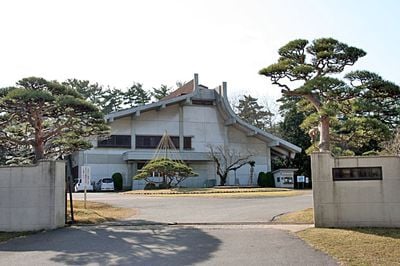
The Homma Museum of Art occupies the Seienkaku, a wooden two-storey villa built in 1813 as a Homma family retreat, with a second storey added in 1908. Its light grey, rough-textured facade rises in a taller central section under a steep brown roof with stepped, curved tiers, and two wide dark horizontal window bands sit above a recessed entrance. A modern annex by Itō Kisaburō was added in 1968, and the Kakubu-en garden, a National Place of Scenic Beauty, borrows Mount Chōkai as scenery.
The villa was originally built by the Homma family, who were among the wealthiest landowners in the region and held considerable influence over local life. Over time, the estate was opened to the public and turned into a museum.
The garden is named Kakubu-en, or "Dancing Crane," and is a National Place of Scenic Beauty. It uses Mount Chōkai as borrowed scenery, so the distant peak is part of the composition. In one corner of the grounds a kiln produces Homma ware, a folk craft sold as a local souvenir.
The museum is within walking distance of central Sakata, making it easy to reach on foot or by public transport. Plan for extra time in winter, as opening hours are shorter and the site is closed on certain weekdays.
The villa served as lodging for feudal lords traveling through the region on official inspection tours, which shows the standing the Homma family held beyond their own lands. Visitors today walk through the same rooms that once hosted high-ranking officials.
The community of curious travelers
AroundUs brings together thousands of curated places, local tips, and hidden gems, enriched daily by 94,227 contributors worldwide.