Ayumizaki kannon, Buddhist temple complex in Kasumigaura, Japan
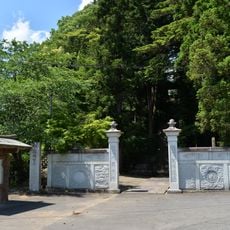
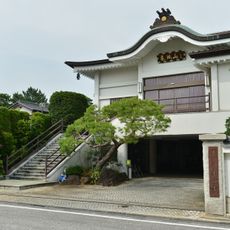
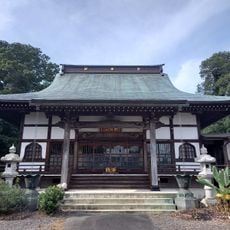
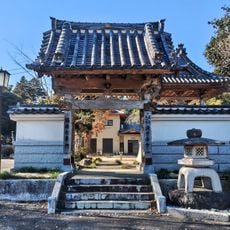
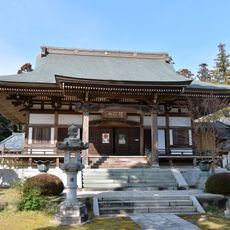
Ayumizaki Kannon, formally Hōshō-in Ayumizakiyama Chōzen-ji, is a Buddhist temple on the Kasumigaura shore in Kasumigaura, Ibaraki. Its main hall (kannondō) was damaged in wartime bombing and is still propped up from behind by logs placed by villagers. The Niō gate stands on the hilltop facing the lake, and a Konpira shrine sits beside an observation deck counted among the Ibaraki Hundred Views.
Tradition holds that in the Tenpyō era the monk Gyōki carved an eleven-faced Kannon in Nara, and a travelling monk enshrined it in a hall on this hill. A document found in 1948 inside the eyes of a Niō statue records that the sculptor Shigetoki of Sawara made the pair in 1534, with the monk Jōrei, restorer of the temple, as donor.
The name Ayumizaki comes from a legend in which a bodhisattva walked across the water to save a ship in distress during the Tenji era (1124–1126). The temple's treasure, a golden loom offered by a dragon princess after a safe childbirth in the Juei era (1182–1184), is shown only once every 33 years, when the Kannon is also unveiled.
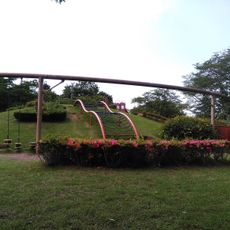
The temple has two approach paths: a steep slope and a gentler one; the lower end now opens onto a park that once led directly to the lakeside. The observation deck beside the Kumbhira shrine offers a view counted among the Ibaraki Hundred Views. The main hall is still propped up by logs placed by villagers after wartime bomb damage.
The temple's treasure is a golden loom (kinbata) offered by a dragon princess, or Ryūnyo, after Kannon answered her prayer for a safe childbirth in the Juei era (1182–1184). Because the main image is shown only once every 33 years, the loom is displayed on the same rare schedule.
The community of curious travelers
AroundUs brings together thousands of curated places, local tips, and hidden gems, enriched daily by 94,369 contributors worldwide.