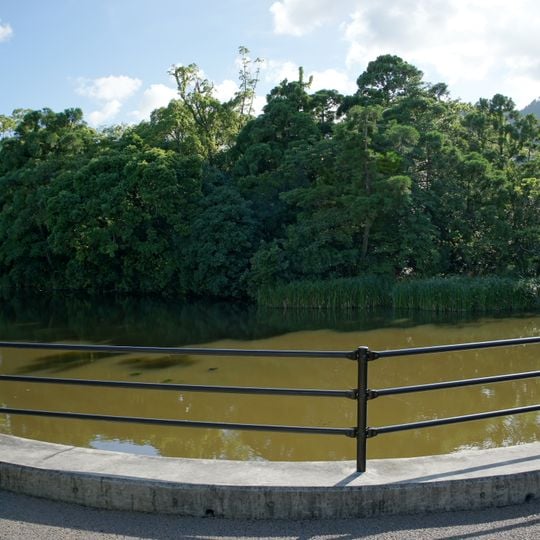
Ukijima no Mori, Floating peat-island plant community in Shingū, Wakayama, Japan
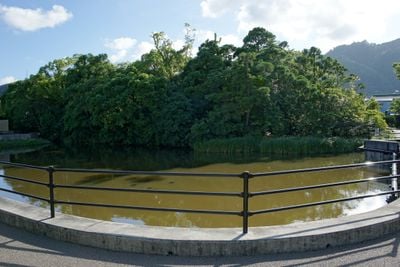
Ukijima no Mori is a plant community on a peat island in a marsh in Shingū, Wakayama Prefecture. The island measures 85 m east-west by 60 m north-south, about 5,000 m², and its peat layer is 30–60 cm thick, with a 5–30 cm water layer beneath. The photograph shows dense green trees rising behind a band of tall reeds at the waterline, with an olive-brown water surface and a dark metal railing in the foreground.
The marsh formed after the Jomon-period sea retreated, and the upper peat layer above the water lens was dated by radiocarbon analysis to around 1710, in the Hoei era. The floating mass was already described in the Kiishokufudoki, compiled between 1806 and 1839, which notes that the wooded island moved when stamped on. It was designated a national natural monument on 8 April 1927.
The forest is the setting of the Oino legend: a girl who went to fetch an akamegashiwa branch for chopsticks was pulled into a bottomless well by a serpent. A pond inside the island, called Ja no Ana (Snake Hole), is identified as that well. Ueda Akinari used the tale for his story "Jasei no In" in Ugetsu Monogatari, later dramatised by Tanizaki Junichiro.
The forest is a 6-minute walk from Shingū Station on the Kisei Main Line. The island sits in a marsh reached by paths; the peat surface is soft and uneven, and the west side rises and sinks slightly with water levels. The site is small, about 85 m east-west and 60 m north-south.
A 1999–2000 survey recorded 64 families and 125 plant species on the island, not 130. These include the high-moor moss Sphagnum and the cold-climate royal fern growing beside the warm-climate fern Tetsuhoshida, with natural sugi (Japanese cedar) as the dominant tree.
The community of curious travelers
AroundUs brings together thousands of curated places, local tips, and hidden gems, enriched daily by 94,373 contributors worldwide.