Gyūba-dōji Statue, Stone sculpture at Hashiori-toge Pass, Tanabe, Japan
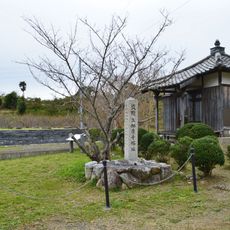
The Gyūba-dōji Statue is a stone figure about 50 cm tall near Hashiori-toge Pass on the Nakahechi route of the Kumano Kodo, in Kōzan, Nakahechi-chō, Tanabe. It shows a small figure seated across the backs of two animals, a cow and a horse. It is a Tanabe City designated historic site.
The statue is said to reproduce the travel attire of Emperor Hanayama, who made a pilgrimage to Kumano in 922, and to have been carved in the Meiji era. The pass name Hashiori-toge comes from the emperor breaking nearby kaya grass to use as chopsticks during a meal stop. The statue was designated a Tanabe City historic site on 26 July 1971.
The name Hashiori-toge comes from a legend that Emperor Kazan, on a pilgrimage to Kumano in 922, broke nearby kaya grass to use as chopsticks during a meal break. The statue itself is a Meiji-era work modelled on his travelling figure, and it was designated a Tanabe City historic site on 26 July 1971.
The statue stands beside the Kumano Kodo Nakahechi route near Hashiori-toge Pass in Nakahechi-cho Kiri-no-to, Tanabe, at about 50 cm tall. It is a small roadside marker on the walking path, so look for it at the pass rather than at a trailhead. The pass name comes from the brushwood broken for chopsticks during a rest stop.
The statue's head was knocked off in June 2008; about 330 people searched without success, so sculptor Tetsunobu Okamura carved a replacement from local sandstone, fixed with stainless-steel bolts in October 2008. Two years later the original head turned up on a bus-stop bench in Tanabe.
The community of curious travelers
AroundUs brings together thousands of curated places, local tips, and hidden gems, enriched daily by 94,039 contributors worldwide.