Sacred Sites and Pilgrimage Routes in the Kii Mountain Range, Religious pilgrimage network in Kii Mountains, Japan.
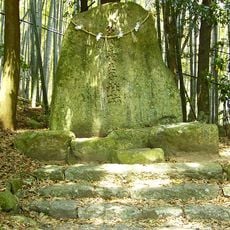
The Sacred Sites and Pilgrimage Routes in the Kii Mountain Range comprise three sacred areas — Yoshino and Omine, Kumano Sanzan, and Koyasan — linked by pilgrimage trails such as the Kumano Kodo, the Omine Okugake-michi, and the Koyasan Choishi-michi. The trails are paved with irregular grey and tan stones, rising in shallow worn steps edged with long rectangular stones and bordered by tall tree trunks. A plain square stone post stands beside the path.
Nature worship in the Kii Mountains predates Buddhism, which arrived from the continent in the 6th century; by the late 7th century the mountains had become a place of ascetic practice. Shingon Esoteric Buddhism reached Koyasan in the 9th century, and Shugendo flourished from the 10th to 11th centuries at Yoshino-Omine and Kumano Sanzan. Routes such as Nakamichi, Omine Okugake-michi and Koyasan-cho Ishimichi were then laid out, and the site was inscribed by UNESCO on 7 July 2004.
The site's name joins three sacred areas: Yoshino and Omine, Kumano Sanzan and Koyasan, linked by pilgrimage routes such as the Kumano Kodo, Omine Okugake-michi and Koyasan-cho-ishi-michi. Shinto and Buddhist practice merged here, and the shrines and temples keep rituals documented over more than 1,000 years. Walkers on the stone-paved ways pass low stone edging and plain square posts marking the route.
The site spans Nara, Wakayama and Mie prefectures, and the trails are only partly registered: sections of the Kumano Kodo, the Omine Okugake-michi and the Koyasan routes, not their full length. The 2016 addition extended the registered Kumano Kodo by 40.1 km, including the Koguchi Pass, Nagao Slope and Shiomi Pass sections. Visitor centres exist in Wakayama and at the Mie Kumano Kodo Centre; Nara has none.
The site was Japan's first World Heritage listing to include routes rather than only buildings, and the first cultural landscape inscribed from the country. Of 242 nominated elements, the trails were entered only in sections, not their full length. In 1998 Wakayama Prefecture paired the Kumano Kodo with Spain's Camino de Santiago as sister routes.
The community of curious travelers
AroundUs brings together thousands of curated places, local tips, and hidden gems, enriched daily by 92,671 contributors worldwide.