Kouyama-ji, Buddhist temple complex in Zentsuji, Japan
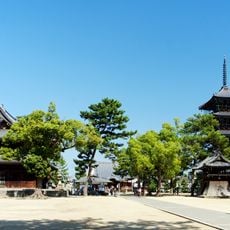
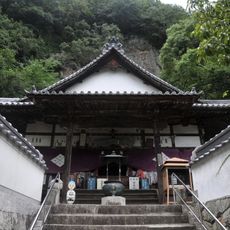
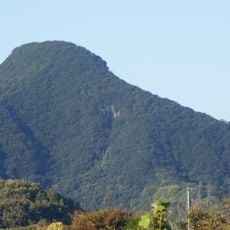
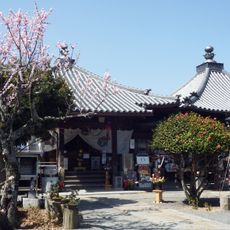
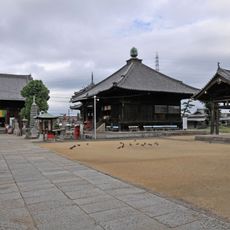
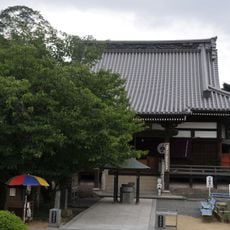
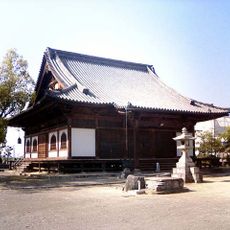
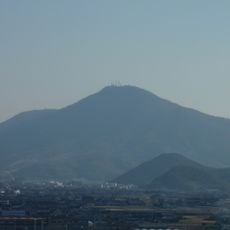
Kōyama-ji is a Shingon temple at the foot of the 87 m Kabutoyama in Zentsūji, Kagawa Prefecture. Its main hall, rebuilt in 1735, houses a seated Yakushi Nyorai carved from single-block hiba pine, with Nikko and Gakko Bosatsu standing beside it. Behind the Daishidō, a hall built into a rock cave 12 m deep holds a stone Bishamonten.
According to temple tradition, Kukai carved a statue of Yakushi Nyorai here while directing the repair of the Manno Pond reservoir; in 821 the court rewarded him with 20,000 coins, part of which built the first hall. Fire during the Tensho era left only the main image and a few treasures. The main hall was rebuilt in 1735 and the Daishido in 1742.
The temple's name comes from Kabutoyama, the hill behind it, and its go Iōzan and Tahōin. Sixteen rabbit figures sit by the gate, inner gate, tea hall roof and water basin because a rabbit is painted among the attributes of Gakkō Bosatsu, the moon bodhisattva beside the main image. The gosho-ka verse names the twelve divine generals.
The temple stands at the foot of the 87 m Kabutoyama, 3.6 km from JR Zentsuji station and 4.5 km from the Zentsuji interchange; a free large car park lies in front of the mountain gate. Inside, the route runs from the gate past the water basin, left through the middle gate to the office, then up a few stone steps to the main hall, with the Daishido and the cave entrance beyond.
Sixteen rabbit figures are placed around the grounds, inside the mountain gate and middle gate, on the tea hall roof and by the water basin, because a rabbit appears among the attributes of Gakkō Bosatsu, the bodhisattva beside the main image. The temple's red seal stamp also shows a rabbit.
The community of curious travelers
AroundUs brings together thousands of curated places, local tips, and hidden gems, enriched daily by 93,453 contributors worldwide.