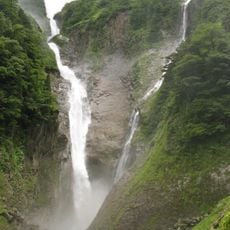
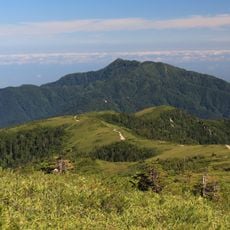
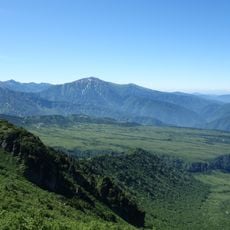
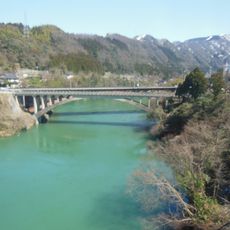
Sukenobu Dam, Gravity dam in Toyama, Japan
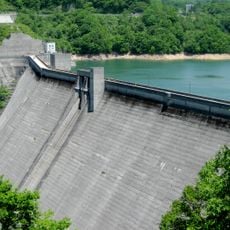
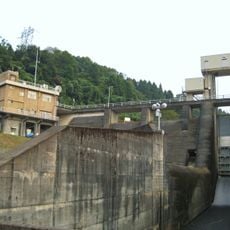
Sukenobu Dam is a 45.5-metre gravity concrete dam on the Koguchi River, a tributary of the Joganji River in Toyama, completed in 1931. It impounds Lake Sukenobu and feeds the Koguchi River No. 3 Power Station, which has a head of 621.2 metres, the highest among conventional hydroelectric plants in Japan.
The dam was built in 1931 during Japan's rapid industrial growth, showing advances in water engineering methods of that era. Its construction was part of the regional infrastructure development in Toyama.
The name Sukenobu is also read Sukenobe, and the reservoir it impounds is called Sukenobu Lake. The dam feeds the Oguchi River No. 3 Power Station, whose effective head of 621.2 m is Japan's highest for an ordinary hydroelectric plant. In 1934 a pumping unit was added to send water back up from the Matate reservoir, an early Japanese example of pumped storage; it was removed in 1968. The old pump and a Johnson valve are kept at the Oguchi River Memorial Hall.
Sukenobu Dam lies west of Arimine Dam across the Sukenobu Pass, inside Arimine Prefectural Natural Park. Since 1994 the Arimine forest road's Koguchigawa line has run along the Koguchi River, linking Arimine Dam past Sukenobu Dam to the Mishu gate. A viewpoint on higher ground overlooks Lake Sukenobu; the dam's concrete surface is weathered and rough from decades of harsh winters.
Sukenobu Dam's concrete surface has been roughened by decades of severe winter cold since its completion in 1931. The dam lies west of Arimine Dam across Sukenobu Pass, and a viewpoint on high ground overlooks Lake Sukenobu. Since 1994 the Arimine forest road's Oguchi River line has run past the dam toward the Mizusu gate.
The community of curious travelers
AroundUs brings together thousands of curated places, local tips, and hidden gems, enriched daily by 94,812 contributors worldwide.