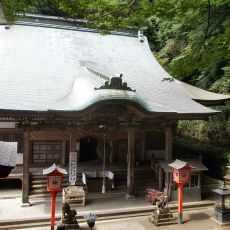
Fukugon-ji, Buddhist temple of the Obaku school in Yanagawa, Japan
Fukugon-ji is an Ōbaku Zen temple in Oshu-machi, Yanagawa, with the sangō name Baigakuzan. Its main hall enshrines Shaka Nyorai, and a cemetery lies behind it. The temple was formerly a Sōtō temple called Tachibanazan Baigaku-ji before its conversion and renaming.
Founded in 1385 as Kakutaniyama Jingū-ji in Tachibana village, the temple became Tachibana Muneshige's family temple and moved to Yanagawa in 1587. Destroyed after the Tachibana were dispossessed following Sekigahara in 1603, it was rebuilt when Muneshige returned as lord in 1620. In 1669 Tachibana Tadashige invited Tetsumon Dōchi, a disciple of Mu'an, and converted it from Sōtō to Ōbaku, renaming it Baigakuzan Fukugon-ji.
The temple is the Tachibana clan's family temple, and the cemetery behind the main hall holds the graves of all nine Tachibana families, including the graves of Muneshige and his wife Ginchiyo. The temple also holds portraits of Tachibana Dōsetsu and Tachibana Muneshige, designated as Fukuoka Prefecture cultural properties in 2026.
Fukugon-ji stands in Oshu-machi, Yanagawa, Fukuoka Prefecture. From Nishitetsu Yanagawa Station on the Tenjin-Omuta Line, take a Horikawa bus and get off at the Nunohashi stop. The temple lies in the back of the main hall, where the cemetery is; the graves of Tachibana Muneshige and his wife Gin Chiyo stand on the grounds.
The temple holds the graves of novelists Ken Hase and Kazuo Dan, and of Tachibana Muneshige with his wife Yinchiyo (Ginchiyo). Two painted portraits, of Muneshige and of his father Dosetsu, were designated Fukuoka Prefecture cultural properties on 27 March 2026.
The community of curious travelers
AroundUs brings together thousands of curated places, local tips, and hidden gems, enriched daily by 93,467 contributors worldwide.