Funabashi-tōshōgū, Shinto shrine in Chiba Prefecture, Japan
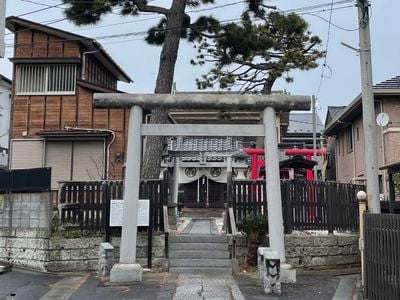
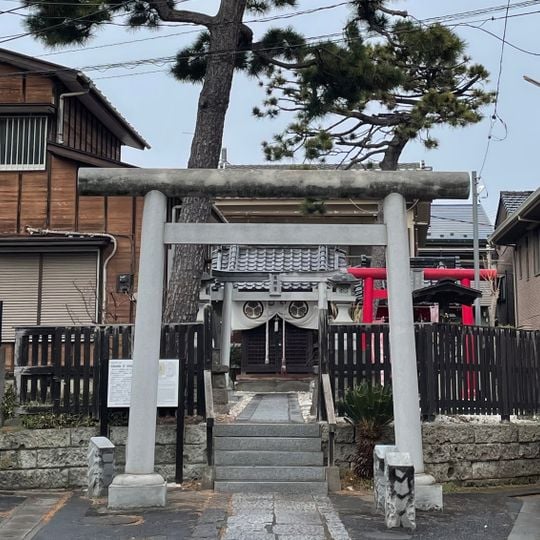
Funabashi-tōshōgū is a small Shinto shrine in Funabashi, Chiba Prefecture, dedicated to Tōshō Daigongen, the deified Tokugawa Ieyasu. A grey stone torii with two cylindrical pillars on square bases and a curved lintel stands at the entrance, its lower crossbar holding a small white plaque. Behind it, stone steps flanked by black wooden fences lead up to a wooden shrine building with a grey tiled roof, a round emblem above dark wooden doors.
The shrine was founded by the Tomi family, priests of Funabashi Daijingū, during the Jōkyō era (1684–1687) on a corner of the former Funabashi Goten, a Tokugawa shogunate residence of about 17,000 tsubo built around 1614 and enclosed by earthen walls and the Ebigawa. The residence was demolished in the Jōkyō era, most of its land became fields, and the Tomi built this small shrine on the remainder. The present building was rebuilt in 1857 and repaired in 1927.
The shrine honours Tōshō Daigongen, the deified Tokugawa Ieyasu, not a sun deity. It was founded in the Jōkyō era (1684–1687) by the Tomi family, priests of Funabashi Daijingū, on a corner of the former Funabashi Palace grounds. The present small structure was rebuilt in 1857 and repaired in 1927.
The shrine stands in Honchō, Funabashi, on the site of the former Funabashi Goten, a Tokugawa lodge of about 17,000 tsubo enclosed by earthen walls and the Ebigawa. Only a small hokora remains today, reached by a short flight of stone steps behind a grey stone torii; a black wooden fence lines both sides of the steps.
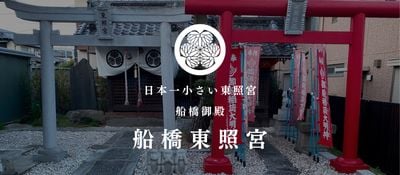
The shrine is known as "Japan's smallest Tōshōgū": only a small hokora remains today. It stands on a corner of the former Funabashi Goten, a roughly 17,000-tsubo compound of earthworks and the Ebigawa that was demolished in the Jōkyō era, after which most of the land became fields.
The community of curious travelers
AroundUs brings together thousands of curated places, local tips, and hidden gems, enriched daily by 93,440 contributors worldwide.