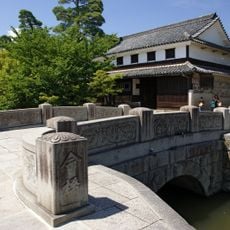
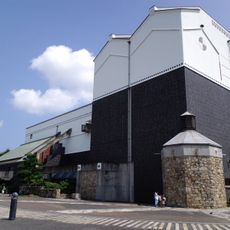
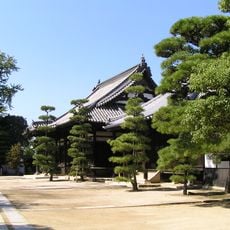
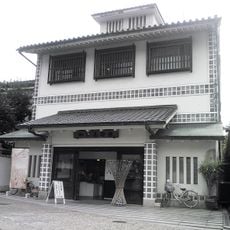
Henjō-in, Buddhist temple in Nishiachicho, Kurashiki, Japan
Henjō-in is a Shingon Buddhist temple in the Nishi-Achi district of Kurashiki, Okayama Prefecture, formally named Jin'yūzan Jingūji Henjō-in. Its main hall enshrines an Eleven-Faced Kannon, and its 21-metre three-storey pagoda, built in 1416, stands beside the neighbouring Kumano Shrine.
According to temple tradition, the monk Chikū founded Henjō-in in 985 on the order of Emperor Kazan, as the jingū-ji of Ataka Shrine. In 1069 it became one of Emperor Go-Sanjō's prayer sites. It once had 31 branch temples, received 2,000 koku from the Mōri in the Tenshō era, and later 50 koku from the Ikeda lords of Okayama.
Henjō-in is the second stop on the Setouchi 33 Kannon Pilgrimage and also serves as the 26th and 27th stop on the Asaguchi 33 Kannon Pilgrimage. Its goeika pilgrim song praises the temple of Nishi-Achi, where the deep vow of great compassion shines everywhere. The main image is an Eleven-Faced Kannon.
Henjō-in lies in Nishi-Achi-chō, Kurashiki, about 15 minutes on foot east of JR Nishi-Achi Station on the Sanyō Main Line. The three-story pagoda stands within the temple grounds next to Kumano Shrine, so the two can be visited together. The pagoda was dismantled and repaired from 1966 to 1967.
The three-story pagoda, rebuilt in 1416 by the monk Chikai, stands 21 meters tall and is crowned with a rare double-bracket support (futatsudo) beneath its eaves. Its wooden nose pieces show Muromachi-period carving. It was dismantled and repaired from 1966 to 1967.
The community of curious travelers
AroundUs brings together thousands of curated places, local tips, and hidden gems, enriched daily by 93,470 contributors worldwide.