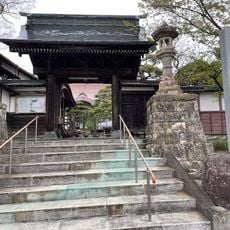
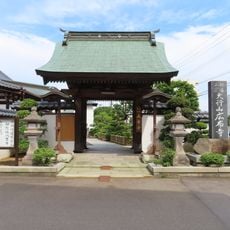
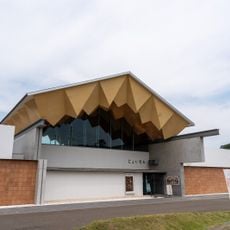
Atsukashiyama Barrier, Medieval fortification in Fukushima Prefecture, Japan
Atsukashiyama Barrier is a medieval fortification in Fukushima Prefecture that stretches across several kilometers and consists of earthen ramparts joined by defensive ditches. The structure took advantage of natural landscape features like the Atsukashiyama hill and the Abukuma River valley to create a strong defensive line.
The Northern Fujiwara built the barrier before 1189 to stop Minamoto no Yoritomo's advance into Oshu; it was held by Fujiwara no Kunihira, son of Fujiwara no Yasuhira. In the 1189 Battle of Atsukashiyama it delayed the Kamakura forces only briefly, and Kunihira was killed. The Azuma Kagami calls its moat "Kuchi Gojo-bori" (five-jo moat), and it was reportedly filled in by Hatakeyama Shigetada.
The site contains double moats and triple earthen fortifications that demonstrate the advanced military engineering techniques of medieval Japanese defensive architecture.
The earthworks run through farmland from the foot of Mount Atsukashi, now called Atsukashiyama, about 4 km south toward the Abukuma River, cut by the Tohoku Main Line, National Route 4 and the Tohoku Expressway. The clearest double moats and triple embankments survive in the Okido and Oeda districts. The site is about 10 minutes by car from Fujita Station on the JR East Tohoku Main Line.
The Azuma Kagami chronicle records the barrier's moat as "Kuchi Gojō-bori" (mouth five-jō moat), and excavations confirmed it: the double moat measured about 15 metres across, matching five jō. The chronicle adds that Hatakeyama Shigetada had the moat filled in during the 1189 campaign. Place names such as Moto-gi (honjō, main fort) and Kami-futae-bori still mark the line.
The community of curious travelers
AroundUs brings together thousands of curated places, local tips, and hidden gems, enriched daily by 94,775 contributors worldwide.