Naniwa Bridge, Arch road bridge in Chūō-ku and Kita-ku, Japan
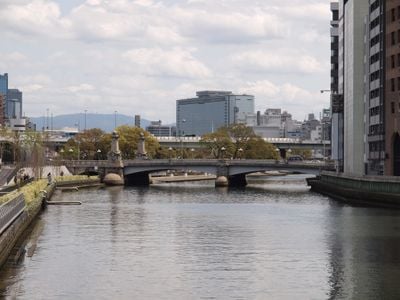
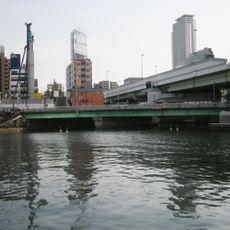
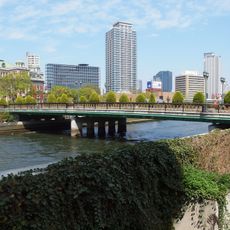
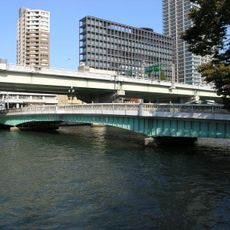
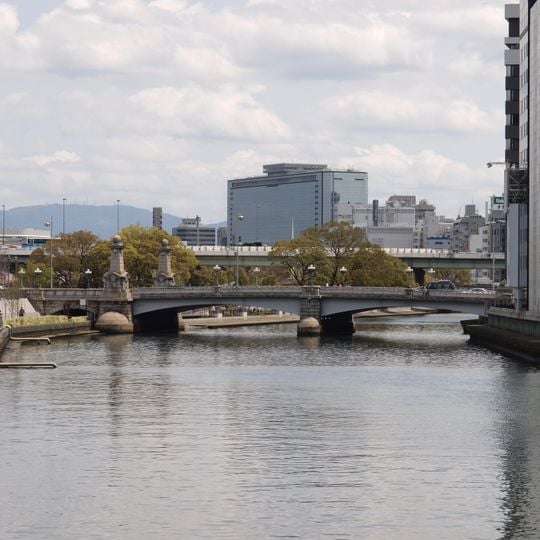
Naniwa Bridge is a 189.7-metre road bridge on Sakaisuji that crosses the Tosabori and Dojima rivers via Nakanoshima. Its grey concrete or stone deck rests on two shallow arches carried by three piers, with a railing along the top. At each end and at the central pier, pairs of pillars with ornamental caps stand, and a lower walkway passes beneath the left arch.
A first bridge near this spot is attributed to the monk Gyōki around 704, and by 1661 the Tokugawa shogunate managed it as an official bridge alongside Tenjin and Tenma. The present steel bridge was built in 1915 on Sakaisuji, one street east of the old Naniwa Bridge alignment, after tram-extension plans met local opposition; it was modelled on Paris's Pont Neuf and Pont Alexandre III. The old bridge was removed when Nakanoshima-dōri was laid out, and the new span took the name Naniwa Bridge. Osaka carried out a major renovation from 1975.
Four stone lions stand at the bridge ends in the Ah-Un configuration, with one showing an open mouth and the other with its mouth closed. These guardian figures are typical of traditional Japanese structures and define the bridge's character as visitors approach it.
The bridge sits near Kitahama Station and works as a key connection point for vehicles and pedestrians between districts. Access is straightforward, and visitors can walk or cross by car at any time to explore the surrounding area.
The bridge's stone lions were modelled on a lion then newly kept at Tennōji Zoo, and the sculptor was Toshioka Kin'ichi, commissioned by Osaka mayor Ikegami Shirō. The left lion has an open mouth and the right a closed one, following the komainu pattern. A replica of the statues stands at the Rokusōen villa in Wakayama.
The community of curious travelers
AroundUs brings together thousands of curated places, local tips, and hidden gems, enriched daily by 93,522 contributors worldwide.