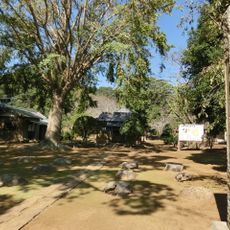
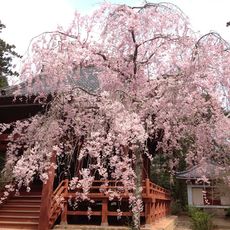
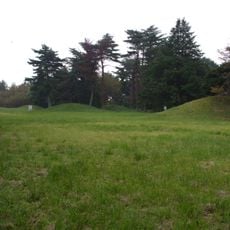
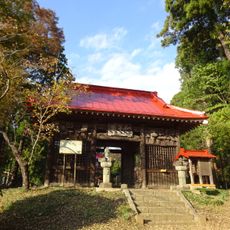
Ryūkakuji Iwaya Kofun, Square burial mound in Sakae, Japan.
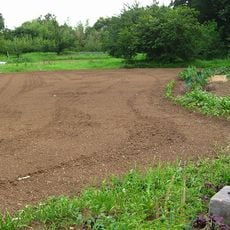
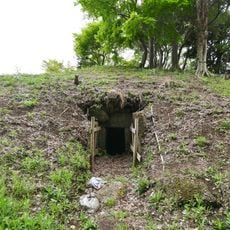
Ryūkakuji Iwaya Kofun is a three-tiered square mound measuring 78 m per side and 13.2 m high, with a 3 m dry moat and outer bank on three sides. Two horizontal stone chambers open onto the south face, 10 m apart; the west chamber is 4.23 m deep and 2.14 m high, while the larger east chamber has collapsed. Both are built of fossil-bearing sandstone from the local Kinoshita shell bed.
Built in the first half or mid-7th century, the mound is the 105th of the Ryūkakuji kofun group. Its two stone chambers were already open by 1591, according to old documents, and became the subject of a legend about borrowed bowls. No grave goods have been found, as no full excavation has taken place. It was designated a national historic site in 1941.
The chambers were already open by 1591, according to old documents, and a legend arose that bowls could be borrowed from them, making the mound an object of folk worship. The soft fossil-bearing sandstone blocks were laid like bricks, and no grave goods have ever been found.
The site is outdoors and can be explored by visitors, with local information centers in Sakae providing directions. It helps to wear comfortable shoes since climbing and walking around the steep mound can be physically demanding.
No burial goods have ever been found here, and the chambers were already open by 1591, when documents record a legend that bowls were lent out from the stone room. A first-order triangulation point now sits on the summit of the mound.
The community of curious travelers
AroundUs brings together thousands of curated places, local tips, and hidden gems, enriched daily by 94,777 contributors worldwide.