Korennaja pustyn', Orthodox monastery in Kursk Oblast, Russia
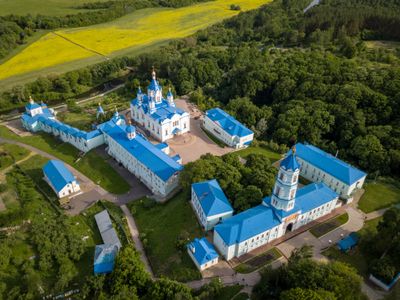
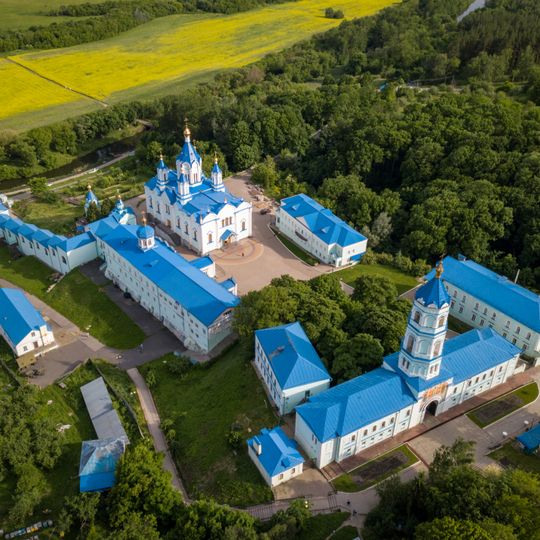
Korennaja pustyn' is a walled monastery complex on a hill above the Tuskar River in Kursk Oblast. Its white-walled buildings carry bright blue roofs: the central Church of the Nativity of the Mother of God has one large dome and smaller domes around it, each topped by a gold cross. A long two-storey building with a small dome runs to the left, and a tiered bell tower rises on the right.
Founded in 1597 by order of Tsar Feodor Ivanovich on the spot where the Kursk Root Icon was found in 1295, the monastery was ravaged by Crimean Tatars in 1611 and rebuilt in 1618. After the 1917 revolution it was renamed Svoboda in 1918, closed in 1924, and its main cathedral blown up between 1924 and 1926; the Russian Orthodox Church regained it in 1989.
The complex serves as a pilgrimage destination for Orthodox believers who come to venerate icons and participate in liturgical chants. Visitors encounter monks in black robes moving between the church buildings, maintaining the rhythm of daily prayer and worship.
Buses run regularly from Kursk city to the nearby settlement of Svoboda, from where the grounds are within walking distance. Visitors should dress modestly as this is an active place of worship, and plan to keep photography outside the church interiors.
A staircase stretching roughly 60 meters (200 feet) descends to a spring by the riverbank, believed to be the spot where the icon was first found. Pilgrims still collect water from the source, attributing healing properties to it.
The community of curious travelers
AroundUs brings together thousands of curated places, local tips, and hidden gems, enriched daily by 94,307 contributors worldwide.