Mirozhsky Monastery, Orthodox monastery in Pskov, Russia
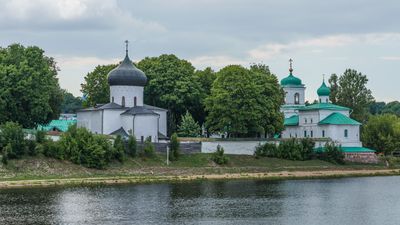
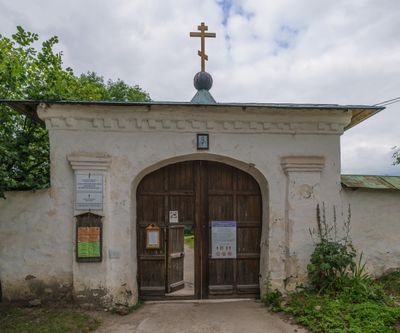
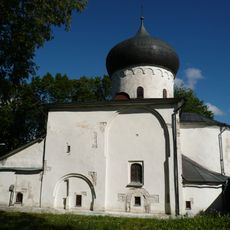
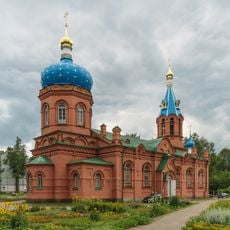
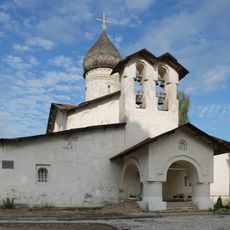
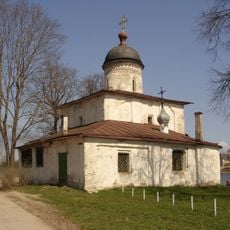
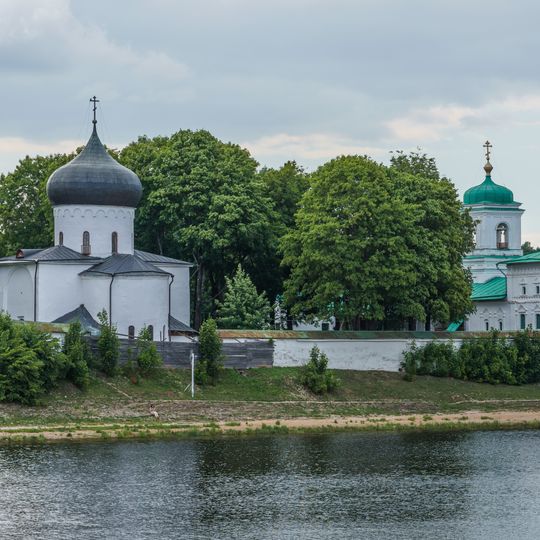
The Mirozhsky Monastery stands on the left bank of the Velikaya River at the mouth of the Mirozha in Pskov's Zavelichye district. Its white-walled ensemble is dominated by the Transfiguration Cathedral, built of plinthite and stone before 1156, with a cross-in-square plan and a dark onion dome. To the right, a white bell tower with a green dome and gold cross adjoins a green-roofed building, while a white wall with an arched gateway encloses the grounds.
The exact founding date is unknown; the monastery is usually dated to the mid-12th century and linked to Nifont, Bishop of Novgorod. Its Transfiguration Cathedral was built of plinthite and stone before 1156. In 1299 Livonian knights burned the monastery and killed hegumen Vasily, later canonized. In 1581 Stefan Batory mounted cannons on the bell tower and fired on Pskov.
The monastery houses twelfth-century wall paintings depicting biblical scenes that reflect early Russian Orthodox artistic traditions. These works form part of the visual heritage that visitors can experience directly inside the cathedral today.
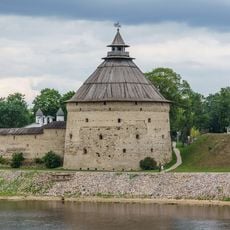
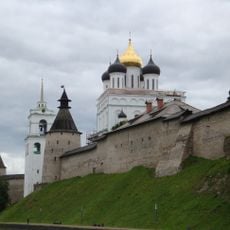
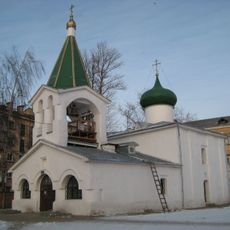
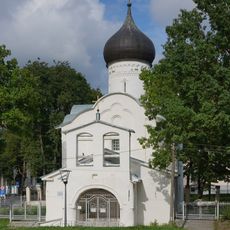
The monastery stands on the spit where the Mirozha meets the Velikaya, on the left bank of the Velikaya, about a twenty-minute walk from the Pskov Krom. The site floods when the rivers rise, with the worst recorded in 1886, 1900, 1928, 1960 and 2011; in April 2011 water stood one metre deep in St Stephen's Church. Check river levels before a spring visit.
The cathedral retains roughly eighty percent of its original medieval frescoes, making it one of the most complete surviving Byzantine painting collections in the world. This exceptional completeness allows visitors to experience the artistic richness of an entire period in ways rarely seen at other medieval sites.
The community of curious travelers
AroundUs brings together thousands of curated places, local tips, and hidden gems, enriched daily by 94,048 contributors worldwide.