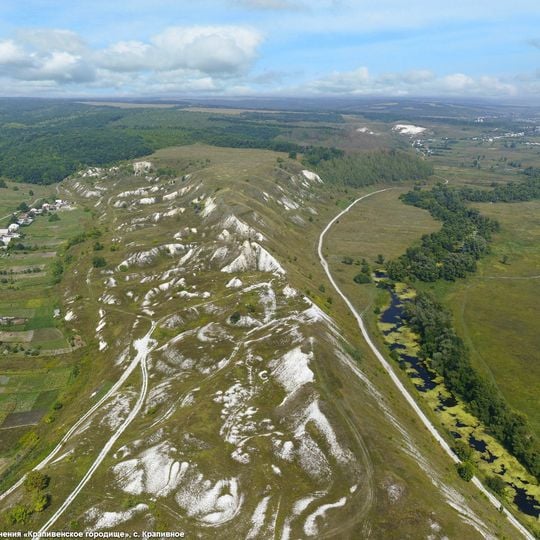
Krapivnoe site of ancient settlement, Archaeological hillfort in Belgorod Oblast, Russia.
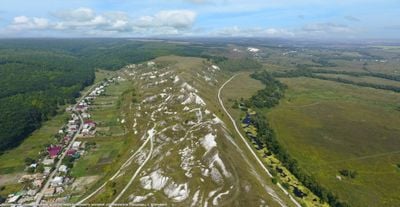
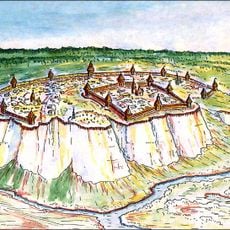
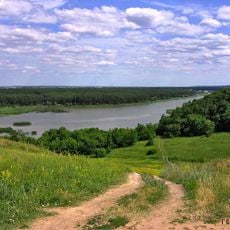
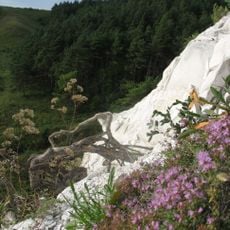
The Krapivnoe site of ancient settlement is a multi-layered hillfort on a high promontory of the right bank of the Koren River, at the northwestern edge of the village of Krapivnoye in Shebekinsky District, Belgorod Oblast. It consists of two parts, a citadel and an outer town, surrounded by unfortified settlements and burial grounds. The photograph shows a long earthen ridge covered with grass and irregular patches of pale exposed chalk, with a dirt path along its lower right base.
Settled by Severians in the 9th–10th centuries, the site was taken by Pechenegs and Cumans before Rus' established a fortified town here in the 12th century, tied to the Kursk appanage of Chernigov. After the Mongol invasion it fell under the Golden Horde and shrank; its inhabitants left in the 15th century as Tatar raids increased and trade routes shifted. Archaeologist S. A. Pletnyova examined it in 1962, and A. G. Dyachenko excavated in 1995 and 2003.
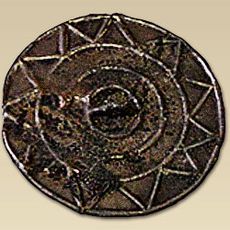
Locals call the hillfort Turetskaya Krepost (Turkish Fortress). Excavations found slate spindle whorls and fragments of glass bracelets, goods brought from the Dnieper region and beyond, and many townspeople were literate. The site is also linked to the medieval town of Milolubl, first mentioned in the 1432 List of Cities of Svidrigailo.
Because this is a protected federal heritage site, it is worth checking with local authorities about any access conditions before visiting. The ground is uneven and there is little shade, so sturdy shoes and water are practical choices for the visit.
Locals call the hillfort Turetskaya Krepost, the "Turkish Fortress". Archaeologist A. G. Dyachenko suggested the town was the Busara or Kharada of the 12th-century Arab geographer al-Idrisi; others identify it with Milolubl, first named in the 1432 "List of Cities of Svidrigailo".
The community of curious travelers
AroundUs brings together thousands of curated places, local tips, and hidden gems, enriched daily by 93,676 contributors worldwide.