Military prison, Orenburg, Military heritage museum in Orenburg, Russia
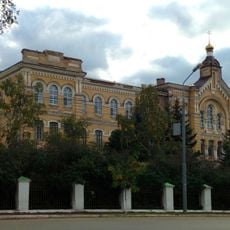
The Orenburg Guardhouse (Gauptvakhta) is a mid-19th-century building in the Belovka district on the high bank of the Ural River, now housing the Museum of the History of Orenburg. Built in 1856 in a neo-Gothic style, it resembles a small medieval fortress: two flat-roofed wings meet at an octagonal tower with narrow embrasures and crenellations. The main entrance is a massive three-sided risalit with pointed arches, and the date "1856" is picked out in coloured brick above the door.
The facility was built in the 19th century to serve as a military prison for the Imperial Russian Army and remained in use for soldiers for many decades. In 1983, it stopped operating as a prison and was converted into a museum open to the public.
The building is known as the Orenburg Hauptwacht, from the German word for a guardhouse. From 1857, by order of Governor-General A. A. Katenin, it held the guard service in its western part and cells for prisoners in the northern wing. A clock from the customs department, previously on the Gostiny Dvor, was installed on the tower; in 1931 it was removed and taken to Samara.
The museum occupies a mid-19th-century building in the Belovka district on the high bank of the Ural River, at the end of Dmitrievsky Lane. The main entrance is on the west facade, framed by a three-sided projection with battlements and a date in coloured brick above it. The building is a federal monument, so access may be limited during restoration work.
The clock on the tower was removed in 1931 and taken to Samara for the newly built House of the Red Army of the Volga Military District. In the early 1980s, at the initiative of Yuri Garankin, a new pendulum clock with a bell chime was made for the tower. The building is a federal cultural heritage site.
The community of curious travelers
AroundUs brings together thousands of curated places, local tips, and hidden gems, enriched daily by 93,491 contributors worldwide.