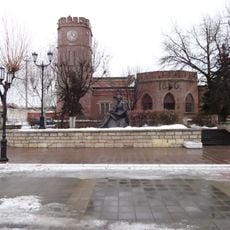
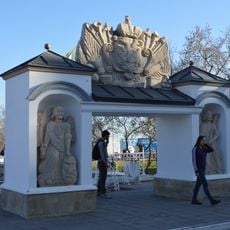
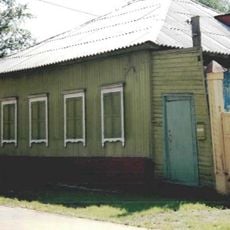
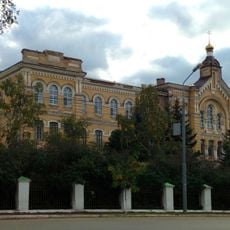
Orenburgskiĭ istoriko-kraevedcheskiĭ muzeĭ, Regional history museum in Orenburg, Russia.
The Orenburg Local History Museum is a regional museum housing diverse collections spanning archaeology, ethnography, and natural sciences. Its holdings include ancient manuscripts, fossils, plant specimens, and archaeological artifacts recovered from the surrounding area.
Founded in 1830, the museum was created to systematically study and document this largely unexplored region. This early establishment made it a pioneering institution for understanding the southern Ural and Volga territories.
The museum holds two copies of the Ostrog Bible printed by Ivan Fyodorov in 1581, one donated by a local resident in the 1960s. Displays also cover writers linked to Orenburg: Sergei Aksakov, Vladimir Dal and Taras Shevchenko. A death mask of Alexander Pushkin, who visited the city in September 1833, is kept here.
The museum occupies a late-classical mansion set back from the street, entered through the main facade with its six-column Ionic portico; the enfilade of state rooms runs along that front. The building is listed as a cultural heritage site, so step-free access and adapted facilities are limited and should be confirmed with the museum before a visit. The open-air Essen courtyard, created in 2022, is reachable during museum events.
A special section displays minerals, plants, and animals native to the region, which sits at the boundary between Europe and Asia. This geographical position makes the collection remarkable, as it contains species from both continents.
The community of curious travelers
AroundUs brings together thousands of curated places, local tips, and hidden gems, enriched daily by 94,537 contributors worldwide.