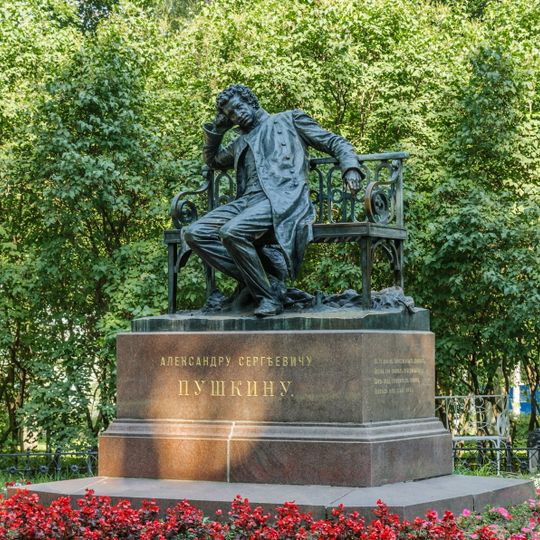
Pushkin Statue in Tsarskoe Selo, Bronze monument in Tsarskoe Selo, Russia
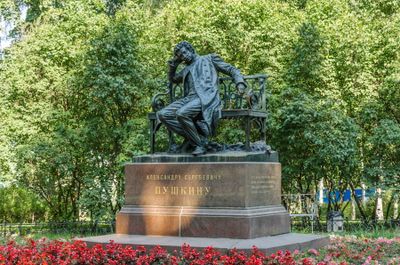
The Pushkin Statue in Tsarskoe Selo is a bronze figure of the poet seated on a bench, leaning back with his right elbow on the armrest and his hand against his head, his left arm along the bench back. He wears a long coat over trousers. The bench, with curved side panels, rests on a tall pedestal of polished reddish-brown stone with stepped top and bottom; gold letters on the front read «АЛЕКСАНДРУ СЕРГЕЕВИЧУ» above «ПУШКИНУ». Low red flowers grow at the base.
The idea of a Pushkin monument arose among lyceum students in 1860, but the first was erected in Moscow in 1880. For Tsarskoye Selo, Nicholas II chose Robert Bach's design; the foundation was laid in 1899 and the bronze was cast at the Stange foundry. The monument opened on 15 October 1900. Damaged in World War II, it was restored and reopened on 17 June 1945.
Pushkin spent his school years in Tsarskoe Selo, and that connection makes this statue feel personal rather than merely official. Visitors often pause here not just to look, but to recite lines of his poetry from memory, something that still happens naturally among Russian travelers.
The statue stands within the open park grounds of Tsarskoe Selo and can be visited without entering any building or paying a separate admission. It works well as a starting point for a walk through the grounds, before heading toward the palace or the gardens.
The sculptor Robert Bach liked this work more than any of his others; in old age he moved to Detskoye Selo and often came to the Lyceum garden to visit it. His brother Alexander, an architect, designed the pedestal. In February 1937 a rally here announced the renaming of Detskoye Selo to the town of Pushkin.
The community of curious travelers
AroundUs brings together thousands of curated places, local tips, and hidden gems, enriched daily by 94,572 contributors worldwide.