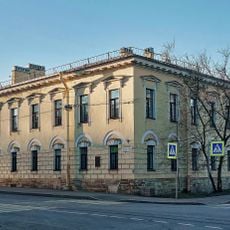
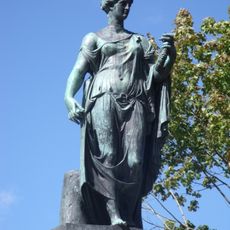
Agate Rooms of Catherine Palace, Palace pavilion in Pushkin, Russia
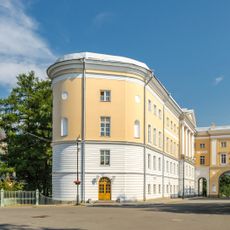
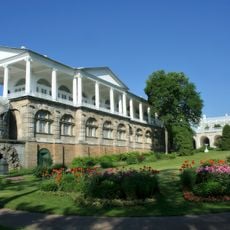
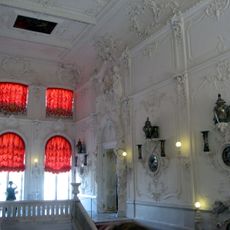
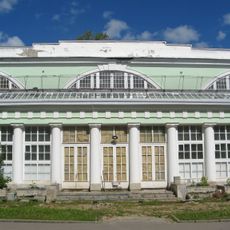
The Agate Rooms occupy the upper floor of the Cold Baths pavilion, Charles Cameron's first realised project in the Catherine Park at Tsarskoye Selo. Three oak doors lead from an oval half-rotunda entrance, the first of its kind in Russia, into the Cabinet, the Great Hall and the Library. The Great Hall and two corner studies keep Corinthian columns of coloured and white marble, marble fireplaces and stucco medallions of Cupid and Psyche.
Catherine II first discussed a Greco-Roman building for Tsarskoye Selo with Falconet, de Wailly and Clérisseau in the 1770s before choosing Charles Cameron, whose Cold Baths with the Agate Rooms became his first realised project there. Construction ran from 1780 to 1781, interior finishing began in 1782, and work continued until 1794. During the German occupation the pavilion housed a club and a stable, and jasper door panels, artificial marble and bronze ornaments disappeared.
The name comes from the agate and jasper that line the walls: the Jasper Study was faced with Ural jasper, and the door leaves carried jasper veneer, lost during the German occupation when the pavilion housed a club and, on the ground floor, a stable. The empress used the upper rooms in the early morning for state papers and letters.
Access requires separate tickets and scheduled guided group tours that depart at set times throughout the day. You should allow enough time to view the wall decorations and furnishings up close.
The upper floor's six rooms were reached from the palace via the Hanging Garden and a staircase from the bel étage. In the Russian bath, 250 cannonballs were piled on a grated vault and doused with water to make steam. During the German occupation the pavilion housed a club and a stable, and the jasper door panels and artificial marble were lost.
The community of curious travelers
AroundUs brings together thousands of curated places, local tips, and hidden gems, enriched daily by 93,996 contributors worldwide.