Creaking Pagoda, Chinoiserie folly in Pushkin, Russia
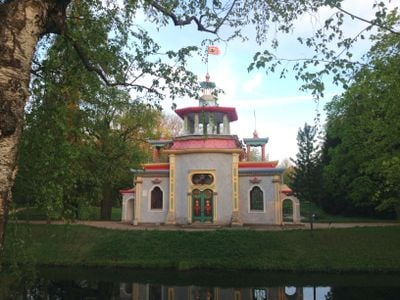
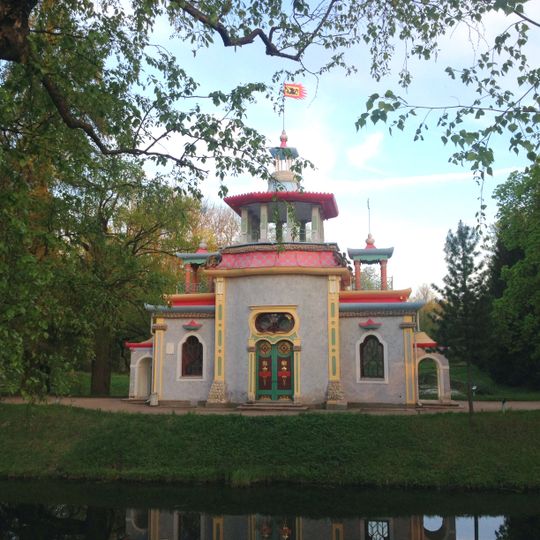
The Creaking Pagoda is a long, narrow chinoiserie folly on a thin isthmus between two ponds in Pushkin, on the line dividing Catherine Park from the New Garden of Alexander Park. Its walls are painted to imitate coloured marble, and gilded wooden dragons by P. I. Brullo sit at the roof corners with bells in their mouths. A twelve-step stone stair narrows as it descends from the main entrance terrace to the water.
Architect Georg von Veldten designed this Chinese-inspired garden building between 1778 and 1786, commissioned by Catherine the Great. It was built at a time when chinoiserie was in high demand across European noble gardens.
The curved roof edges and dragon figures at the corners make the Chinese influence immediately visible to any visitor. This kind of design was fashionable among European nobles in the 18th century, especially in garden settings.
The pagoda stands on the narrow isthmus between two ponds, on the boundary between Catherine Park and the New Garden of Alexander Park, just beyond the Chinese Village. Visitors approach on foot through the park; the ground near the water can be uneven and damp after rain, so wear sturdy shoes.
The weathervane is shaped like a Chinese banner, not a rooster or arrow, and its creak gave the pavilion its Russian name, Skripuchaya besedka. Look for the gilded wooden dragons by P. I. Briullo at the roof corners, each holding a bell in its mouth.
The community of curious travelers
AroundUs brings together thousands of curated places, local tips, and hidden gems, enriched daily by 93,345 contributors worldwide.