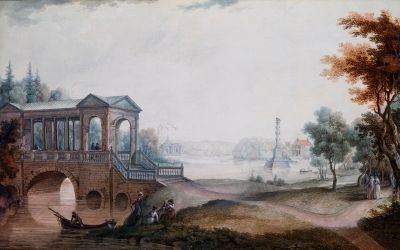
Marble Bridge, Neoclassical bridge in Catherine Park, Pushkin, Russia
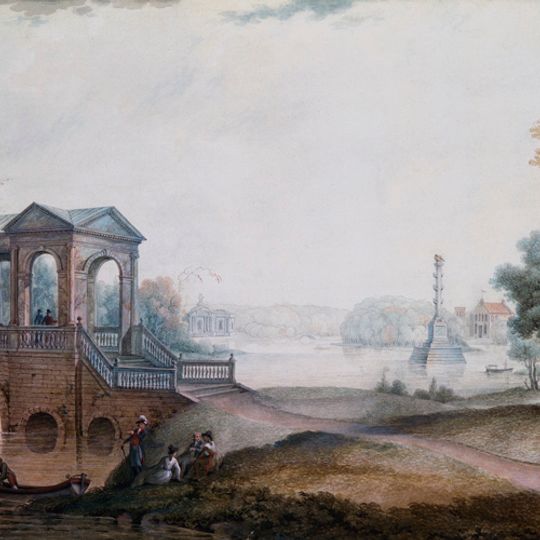
The Marble Bridge is a pedestrian bridge in Catherine Park, Pushkin, built 1772–1774 to a design by Vasily Neyelov after the Palladian Bridge at Wilton House. A granite base on five arches carries a roofed marble gallery with an Ionic colonnade and two pavilions, assembled from Ural marble parts cut at the Yekaterinburg lapidary works under Vincenzo Tortori.
The bridge was built between 1772 and 1774 to a design by Vasily Neyelov, who adapted the Palladian Bridge at Wilton House (1736–37) by Roger Morris. The granite foundation on five arches cost 7,861 rubles 67¾ kopecks from the Imperial Cabinet. Marble details were carved at the Yekaterinburg lapidary factory under Florentine master Vincenzo Tortori and assembled in 1774.
The bridge's name Siberian Marble Gallery comes from the Ural marble, then called "Siberian", used for its columns, capitals, pedestals and balusters. The parts were carved at the Yekaterinburg lapidary factory under the Florentine stonecutter Vincenzo Tortori, who came to the Urals in 1765. In 1778 the English traveller William Cox, touring with his pupil Lord Herbert, noted its likeness to the Wilton House bridge.
The bridge functions as a pedestrian walkway connecting different sections of the former royal residence and park grounds. Access is straightforward as it sits within the estate's main walking routes during standard park hours.
Two square pavilions sit above the central and side arches, connected by slender columns carved from blue-grey marble sourced from a specific Ural region. This unusual combination of functional walkway and decorative pavilion space creates a structure that works both as passage and gathering point.
The community of curious travelers
AroundUs brings together thousands of curated places, local tips, and hidden gems, enriched daily by 94,020 contributors worldwide.