Chinese Village, Folly in Pushkin, Russia
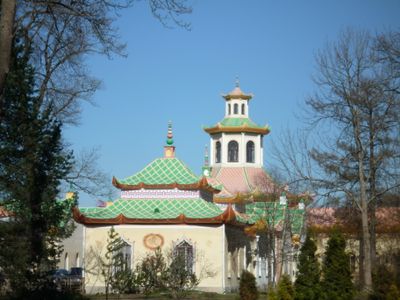
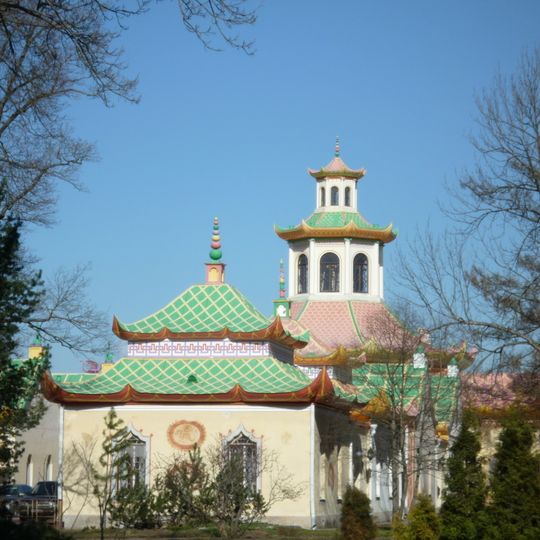
Chinese Village is a group of ten decorative buildings with bright facades and Oriental-inspired architectural details located within a park setting. The structures combine European building traditions with ornamental elements designed to evoke an exotic appearance.
The complex was commissioned in the 1770s by the Russian empress to create a fantastical interpretation of Chinese design. The ambitious project was originally planned to include eighteen houses but was never fully completed.
The village's name comes from the 18th-century European fashion for Chinoiserie, and Catherine II had the houses modelled on a Chinese engraving from her own collection. The Dragon Bridge takes its name from four zinc winged dragons, while the Large Chinese Bridge is known for pink granite vases and imitation coral branches. The nearby Chinese Opera Theatre, built in 1779, hosted Giovanni Paisiello's operas and the premiere of Leo Tolstoy's The Fruits of Enlightenment before burning down on 15 September 1941.
The ten cottages were converted in the 1990s into 28 rental apartments, so interiors are closed to casual visitors; the facades, the green-and-white diamond roof and the pink tent-roofed tower behind are seen from the paths of Alexander Park. Five bridges lead toward the village, among them the Dragon Bridge and the Large Chinese Bridge.
Five bridges lead to the village. The Dragon Bridge carries four zinc figures of winged dragons, and the Large Chinese Bridge is known for pink granite vases and imitation coral branches; both were finished in 1785. The Cross-Shaped Bridge by the Neyelov brothers came six years earlier, and statues of four Chinese by sculptor Schwarz were added to the Large Chinese Bridge in 1860.
The community of curious travelers
AroundUs brings together thousands of curated places, local tips, and hidden gems, enriched daily by 94,108 contributors worldwide.