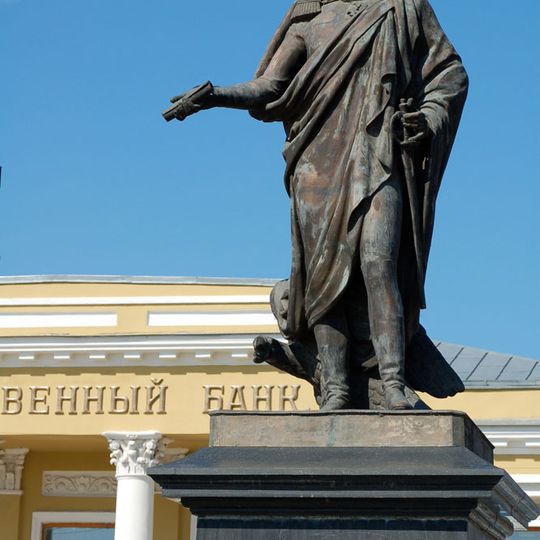
Alexander I Statue in Taganrog, Bronze monument in Bank Square, Taganrog, Russia.
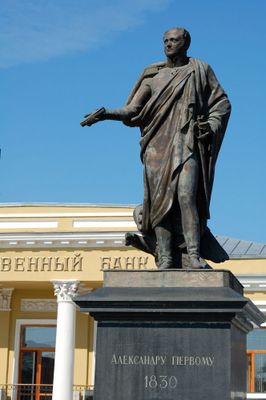
The Alexander I Statue in Taganrog is a full-length bronze figure of the emperor in a general's uniform with a draped cloak, sculpted by Ivan Martos and architect Avraam Melnikov. The original stood on a massive grey granite pedestal with white veins and five steps, the tsar trampling a coiling snake (victory over Napoleon), holding a sword hilt and a scroll of laws, with winged angels at his feet. The 1998 copy omits the snake and cupids.
The monument was unveiled in 1831 to honor Emperor Alexander I, who had strong ties to Taganrog and spent his final days in the city. The depiction with symbols like the sword relates to his role during the Napoleonic Wars and his importance for Russia.
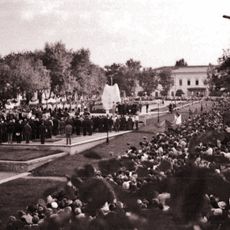
The monument was funded largely by the Romanov imperial family, with the rest raised by the people of Taganrog, and it was unveiled on 23 October 1831 with church services, a salute, bells in all churches and evening illuminations. The pedestal bore a short inscription on its front face. In 2021 artist Yuri Fesenko painted the elder Fyodor Kuzmich in water on the paving in front of the statue for the art project "Personal City".
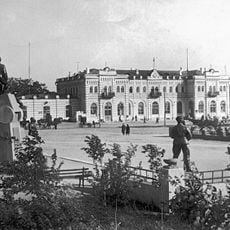
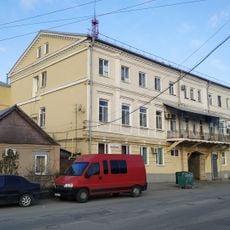
The monument stands off-center on Jerusalem Square, shifted toward the nearby apartment building, facing the Greek Monastery of Alexander Nevsky. Five steps lead up to the pedestal, and cast-iron posts with chains were added around it years after the 1998 reopening. The square was planted and fenced with forged railings back in 1888.
The 1998 copy omits the serpent and cupids of Martos's original, which the organisers judged too remote a reference to the Napoleonic invasion. The original model is held by the Russian Museum in Saint Petersburg. In 2021 artist Yuri Fesenko painted an image of Elder Feodor Kuzmich in water on the pavement before the statue.
The community of curious travelers
AroundUs brings together thousands of curated places, local tips, and hidden gems, enriched daily by 93,646 contributors worldwide.