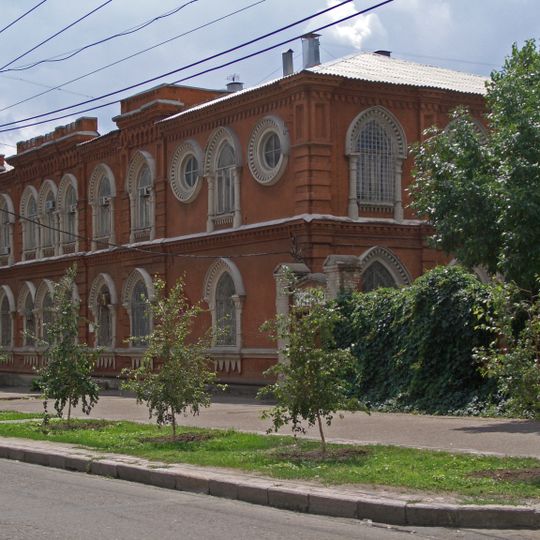
Second Volgograd Synagogue, Choral synagogue in Voroshilovskiy District, Russia
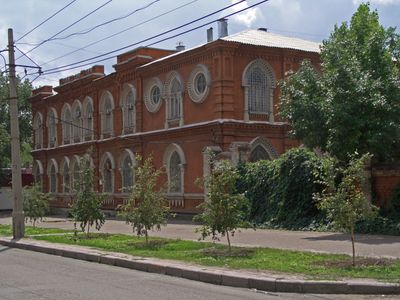
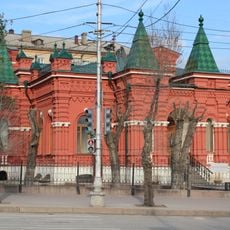
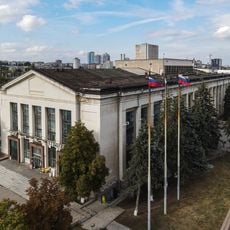
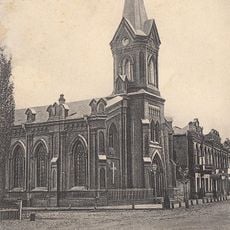
The Second Tsaritsyn Synagogue is a rectangular brick building at 11a Port-Said Street, its facades split into three sections with a wider middle one. Figurative brickwork shapes the decor: pilasters under an arcaded frieze, pointed arches on cubical capitals, and large windows with Art Nouveau frames, including round windows on the north side. Inside, the choir balconies were replaced by a solid second floor.
In 1905 residents S. E. Ranter, B. Ts. Rabinovich and L. B. Shapiro petitioned the Saratov province building department for a Jewish prayer house at the corner of Kurskaya (now Port-Saida) and Smolenskaya streets. Engineer Yu. N. Terlikov rejected the first project in June 1906 over dome-load calculations and fire safety; it was approved on 24 January 1907 and the synagogue was completed in 1911. The Stalinograd executive committee closed it on 17 November 1929, and on 13 April 1930 the building was handed to the regional health department for a polyclinic; the domes were dismantled and the Stars of David plastered over. It survived the Battle of Stalingrad without serious damage.
The building has not served as a synagogue since its closure by decision of the Stalinograd executive committee on 17 November 1929. Its domes were dismantled and the Stars of David on the walls were knocked off and plastered over. Since 1930 it has housed a physiotherapy clinic, and attempts by Volgograd's Jewish community to recover it in 2007 and 2016 failed.
The former synagogue stands at Port-Saida Street 11a, not on Balahinskaia Street. It now houses a municipal physiotherapy clinic, so visits are tied to clinic hours rather than religious services. The 1926–1928 brick fence with iron gates is part of the protected heritage ensemble.
The building's structure rests on cast-iron columns and Monier vaults, metal techniques new for their time; engineer Vasiliev-Vasilkov's 1911 report noted fourteen I-beams carrying the second-floor choir galleries. The brick fence with iron gates, added in 1926–1928, is part of the protected heritage object.
The community of curious travelers
AroundUs brings together thousands of curated places, local tips, and hidden gems, enriched daily by 93,972 contributors worldwide.