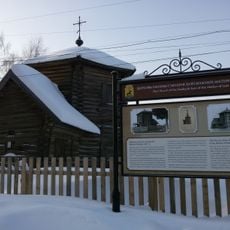
Lyudmila's Well, Solikamsk, Salt extraction well in Solikamsk, Russia
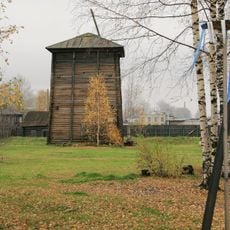
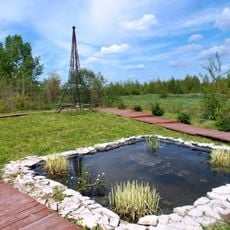
Lyudmila's Well is a salt borehole in Solikamsk, drilled in 1906 by Nikolai Ryazantsev on the grounds of the Troitsky saltworks. It is a narrow shaft about 98 metres deep that yields brine and is now a working well with water flowing to the surface. The site was landscaped in 2010 for pedestrians and is part of Solikamsk's Green Line.
The well was drilled in 1906 by Nikolai Ryazantsev at the Troitsky saltworks of I. V. Ryazantsev to locate salt beds. At 98 metres he found bitter yellow salt with red veins, later analysed as potassium chloride with iron. Drilling finished in 1910, a pump was installed, and the well began operating on 30 August 1910, named after I. V. Ryazantsev's wife Lyudmila. It ran until 1923, when the Troitsky plant closed.
The well is named after Lyudmila, the wife of salt-works owner Ivan Ryazantsev, not a manager. Its brine, rated at 24 degrees, was valued at 250 rubles per degree, and the whole well at 6,000 rubles. Today it is a stop on Solikamsk's Green Line walking route.
The site is best reached by visiting with a guided tour arranged through the Solikamsk Salt Museum, which provides context for what you are seeing. Visitors should be prepared for wet or muddy ground around the structure, especially during wetter seasons when groundwater levels rise.
The well is named after Lyudmila, the wife of saltworks owner Ivan Vasilyevich Ryazantsev, not a manager. Drilled in 1906 to locate salt layers, it struck yellow salt with red veins at 98 metres; analysis in 1910 found potassium chloride, leading to the discovery of the world's largest potash deposit, Verkhnekamskoye.
The community of curious travelers
AroundUs brings together thousands of curated places, local tips, and hidden gems, enriched daily by 94,590 contributors worldwide.