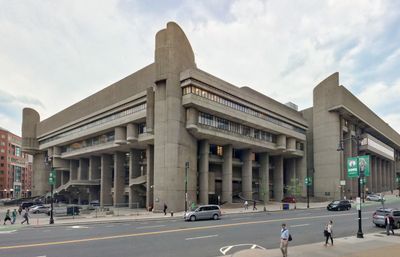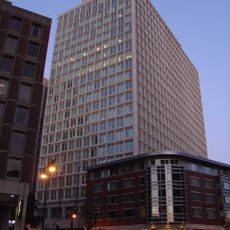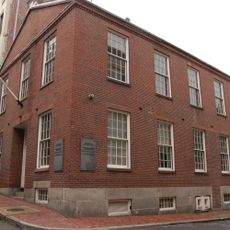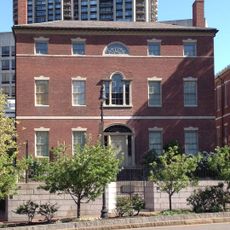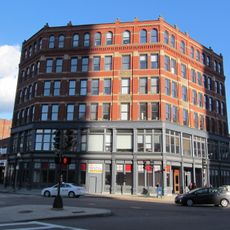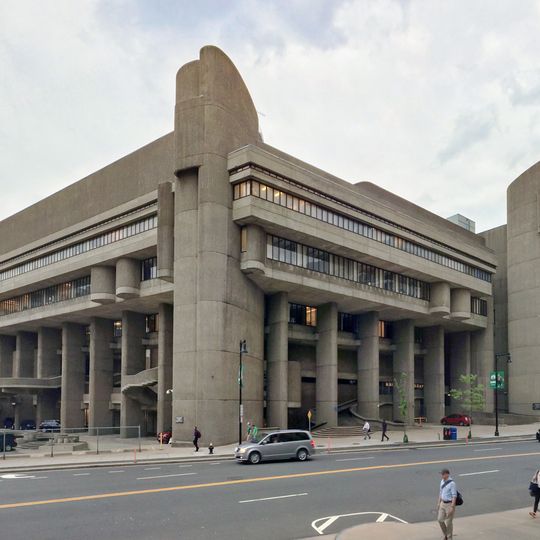
Government Service Center, Brutalist office building in Government Center, Boston, United States
The Government Service Center consists of two connected concrete structures, the Charles F. Hurley Building and the Erich Lindemann Building, occupying 8.5 acres.
Construction of the Boston Government Service Center began in 1963 and concluded in 1971, replacing sections of the former residential West End neighborhood.
The interior of the Hurley Building features murals by Costantino Nivola depicting themes related to employment and societal benefits of unemployment insurance.
The Hurley section houses the Division of Unemployment Assistance and MassHire, while the Lindemann building contains the Massachusetts Department of Mental Health offices.
The Hurley Building section of the complex follows the geographical outline of Massachusetts, though architect Paul Rudolph stated this resemblance was unintentional.
Location: Boston
Architectural style: brutalist architecture
GPS coordinates: 42.36250,-71.06300
Latest update: December 1, 2025 09:13
Brutalist architecture emerged in the decades following World War II, producing buildings that challenged conventional design through their honest expression of materials and function. From Le Corbusier's Unité d'Habitation in Marseille to Louis Kahn's National Assembly in Dhaka, these structures define a global movement that prioritized raw concrete, bold geometric forms and exposed construction elements. The style reached across continents, shaping university libraries in Chicago, government buildings in Boston and Chandigarh, residential towers in London, and cultural centers in São Paulo. Each building reflects the architectural philosophy of its time, when architects sought to create functional spaces through direct expression of structure and material. This collection documents examples from Europe, Asia, North and South America, representing the full range of building types that defined the movement. You'll find administrative complexes that house parliaments and municipal offices, educational facilities serving major universities, residential towers providing urban housing, and cultural institutions including museums and theaters. The structures share common characteristics—concrete left exposed to show its texture and formwork patterns, geometric compositions that emphasize mass and volume, and architectural elements that reveal rather than conceal how buildings stand and function. These sites offer insight into a period when architects reimagined how modern cities could be built and how public spaces could serve their communities.
John F. Kennedy Federal Building
320 m
African Meeting House
347 m
Thomas P. O'Neill Jr. Federal Building
301 m
Saltonstall Building
256 m
Abiel Smith School
328 m
First Harrison Gray Otis House
183 m
Bulfinch Triangle Historic District
204 m
John Coburn House
372 m
Concert Hall (Boston)
322 m
Charles Sumner House
349 m
West End Museum
207 m
Massachusetts Law Enforcement Memorial
360 m
Thermopylae
318 m
Bust of Richard Cushing
119 m
Peter Faneuil School
356 m
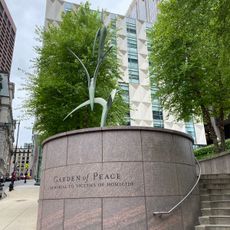
Garden of Peace
295 m
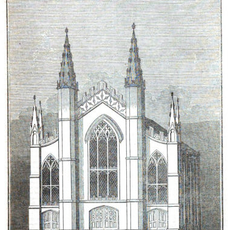
Grace Church
325 m
Causeway
223 m
Buck's American Bar and Grill
248 m
Chet's Last Call
236 m
Museum of African American History
335 m
McCormack Building
339 m
McGann's Irish Pub
264 m
Commonwealth Brewing Company
194 m
Otis House Museum
171 m
Charles Cinema
273 m
C. Walsh Theatre
297 m
Chameleon
261 mReviews
Visited this place? Tap the stars to rate it and share your experience / photos with the community! Try now! You can cancel it anytime.
Discover hidden gems everywhere you go!
From secret cafés to breathtaking viewpoints, skip the crowded tourist spots and find places that match your style. Our app makes it easy with voice search, smart filtering, route optimization, and insider tips from travelers worldwide. Download now for the complete mobile experience.
A unique approach to discovering new places❞
— Le Figaro
All the places worth exploring❞
— France Info
A tailor-made excursion in just a few clicks❞
— 20 Minutes