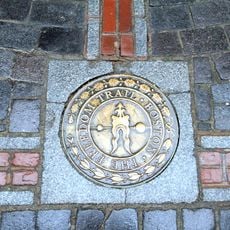
Boston Stone, Historical stone marker on Marshall Street, Boston, US.
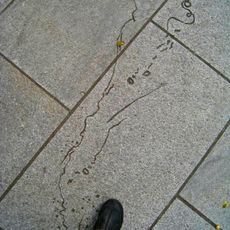
The Boston Stone is a circular sandstone block set into the exterior foundation wall of a building on Marshall Street, in downtown Boston. A painted hand on the brickwork points directly to it, marking its exact position at ground level.
Around 1700, an English miller named Thomas Childs brought the stone to the colony and used it to grind paint pigments at his mill. In 1737, a group of Boston merchants embedded it in a building wall and declared it the official central point from which distances in and around the city would be measured.
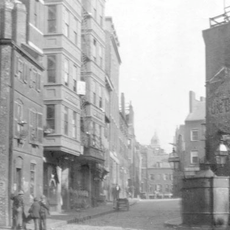
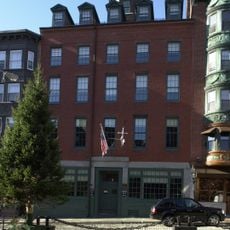
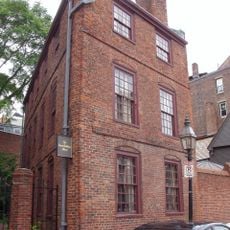
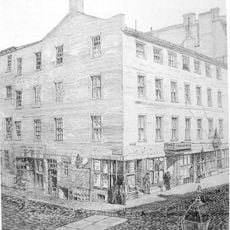
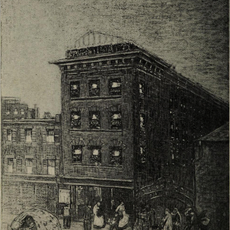
The Boston Stone sits in the Blackstone Block, one of the oldest surviving street clusters in the city, surrounded by colonial-era buildings. Visitors walking past can see how naturally the stone has been absorbed into everyday city life, almost hidden in plain sight.
The stone is on Marshall Street, in the middle of a busy block in the historic district, and can be found by following the painted hand on the building facade. It sits at ground level, so it helps to slow down and look along the base of the wall rather than at eye height.
The idea behind the 1737 placement was to give Boston a fixed central point for measuring distances, modeled after the London Stone in England. That plan never took hold in practice, so the stone ended up as a marker without a function it was actually used for.
The community of curious travelers
AroundUs brings together thousands of curated places, local tips, and hidden gems, enriched daily by 92,742 contributors worldwide.