Temple of Debod, Ancient Egyptian temple in Moncloa-Aravaca, Madrid, Spain
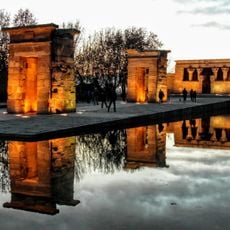
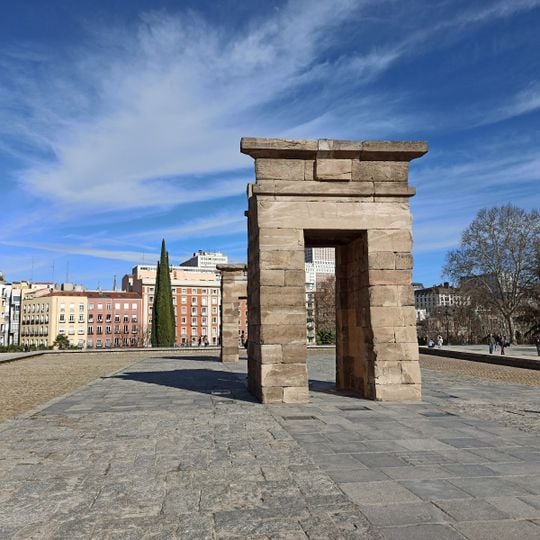
The Temple of Debod is a small ancient Egyptian temple of sandstone blocks in Madrid's Parque del Oeste, measuring 12 by 15 metres. Its core is the chapel of Adikhalamani, later surrounded by Ptolemaic and Roman additions. Two free-standing stone pylons with flared cornices stand on a paved surface before the colonnaded building.
The building originated in the second century before our era under Nubian rulers in Upper Egypt and came to Madrid in 1968 after flooding threatened from the Aswan Dam. Spain had participated in the international rescue campaign for the Nubian monuments and received the temple as a gift from Egypt.
The name comes from Debod, a site on the Nile's bank south of Aswan, near the first cataract, where the sanctuary was linked to the cult of Amun of Debod and, from the 1st century BC, to the Isis sanctuary at Philae. The chapel of Adikhalamani preserves reliefs showing the king ordering the monument built for his father Amun.
The temple stands on a raised platform in the Parque de la Montaña, west of the Plaza de España, and is reached on foot from the Paseo del Pintor Rosales. The reassembled gateways are arranged in a different order than at the original site, so the approach sequence differs from ancient Debod. The structure remains exposed to the elements; the city council voted in February 2020 to accelerate plans to cover it.
The stones traveled by ship and truck over more than 3000 kilometers and were reassembled on an artificial hill that mimics the original height above the Nile. The water basin around the base recalls the location on the river island.
The community of curious travelers
AroundUs brings together thousands of curated places, local tips, and hidden gems, enriched daily by 92,093 contributors worldwide.