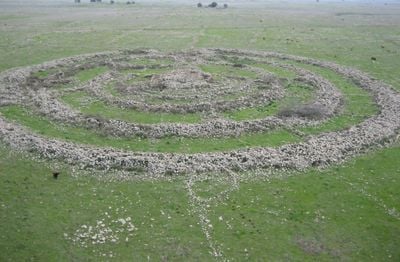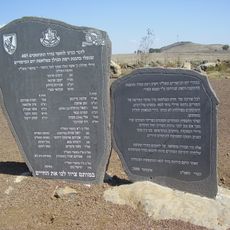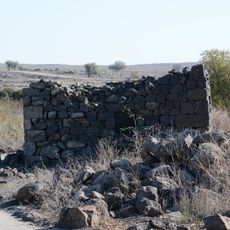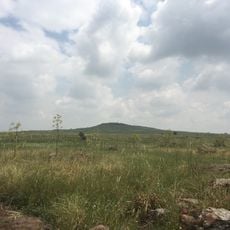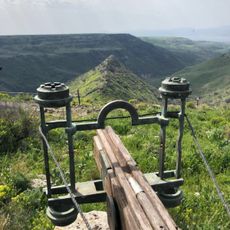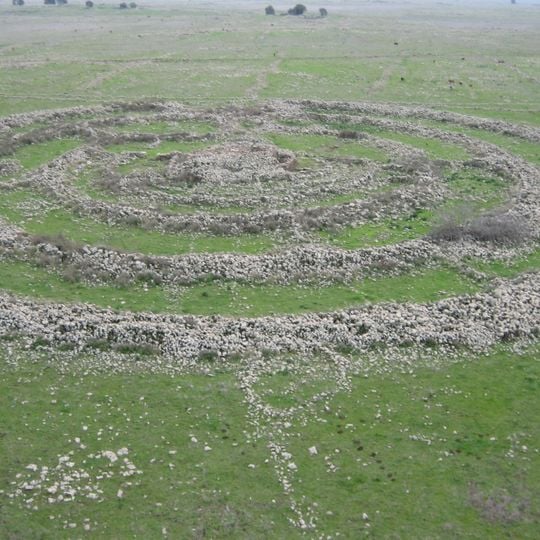
Rujm el-Hiri, Megalithic monument in Golan Heights, Israel.
The circular monument consists of five concentric rings constructed with 42,000 basalt rocks, reaching heights of 8 feet and spanning 520 feet in diameter.
Archaeologists date the establishment of the stone formation to the Early Bronze Age II period between 3000 and 2700 BCE, prior to its central burial mound.
The Arabic name translates to 'stone heap of the wildcat' while the Hebrew name Gilgal Refaim refers to the 'Wheel of Spirits' in local traditions.
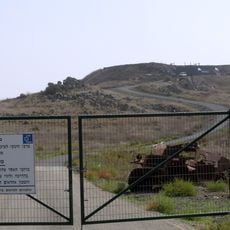
The monument requires permission to visit due to its location near military zones, with access primarily restricted to weekends throughout the year.
The structure aligns with astronomical events as sunlight passes through specific openings during solstices and equinoxes, suggesting an ancient calendar function.
Location: Northern District
Height: 4.5 m
GPS coordinates: 32.90865,35.80104
Latest update: May 27, 2025 11:45
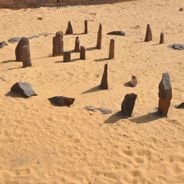
Stone circles stand among humanity's earliest architectural accomplishments, constructed by prehistoric communities across Europe and beyond over thousands of years. These circular arrangements of standing stones served multiple purposes, functioning as astronomical observatories where ancient peoples tracked celestial movements, seasonal changes, and solar events. The monuments also acted as communal gathering spaces for ceremonies, trade, and social activities. The engineering skills required to transport, raise, and position these massive stones—some weighing several tons—reveal the sophisticated organizational capabilities and technical knowledge of Neolithic and Bronze Age societies. This collection spans numerous locations throughout Europe. In England, Stonehenge features precisely arranged upright stones forming a 98-foot (30-meter) circle built between 3000 and 2000 BC, while the Avebury complex measures 1,086 feet (331 meters) across and dates to 2850 BC. Scotland hosts several significant sites, including the Callanish Stones with a central monolith standing 16 feet (4.8 meters) tall, and the Ring of Brodgar, which originally contained 60 stones encircled by a 30-foot (9-meter) wide ditch. The Castlerigg Stone Circle sits surrounded by Lake District peaks, constructed around 3000 BC. Beyond the British Isles, Germany's Goseck Circle demonstrates astronomical alignment dating to 4900 BC, making it one of the oldest known structures of its kind. Ireland's Drombeg Stone Circle uses 17 stones to mark solstice positions. Each site provides insight into how prehistoric communities observed the heavens, marked time, and organized their societies around these enduring monuments.
Bethsaida
15.9 km
Tal Saki
5.5 km
Hexagon pool
13.1 km
Luna Gal
15.6 km
Gamla nature reserve
5.7 km
Ophir Overlook
16.6 km
Tall al Faras
8.3 km
Katzrin ancient village and synagogue
12.7 km
Golan Archaeological Museum
14.3 km
Jordan River park
16 km
Deir Aziz Ancient synagogue
9.6 km
405th Reg. memorial
3.8 km
Tel Juhader
5.2 km
Yehudiya Forest Nature Reserve
10.9 km
Mount Yosifon
16.5 km
עין נשוט
15.5 km
Nov Nature reserve
8.1 km
Deir Qeruh
5.2 km
179th brigade memorial
9.6 km
שמורת הר פרס
7.8 km
Giv'at Bezek
3.6 km
Qasr Bardawil
11.3 km
Hurvat Zmimrah
12.1 km
Gush Hispin
8.6 km
281th Medical Regiment memorial
13.2 km
Et-Tell
15.9 km
פינת חי
13.6 km
מרכז הזוחלים בקצרין
12.5 kmReviews
Visited this place? Tap the stars to rate it and share your experience / photos with the community! Try now! You can cancel it anytime.
Discover hidden gems everywhere you go!
From secret cafés to breathtaking viewpoints, skip the crowded tourist spots and find places that match your style. Our app makes it easy with voice search, smart filtering, route optimization, and insider tips from travelers worldwide. Download now for the complete mobile experience.
A unique approach to discovering new places❞
— Le Figaro
All the places worth exploring❞
— France Info
A tailor-made excursion in just a few clicks❞
— 20 Minutes