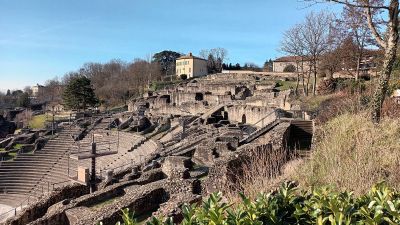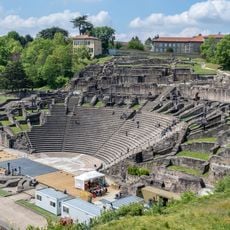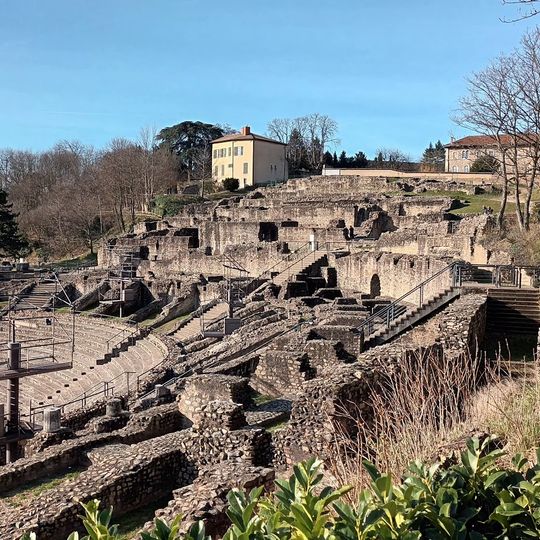
Théâtre Gallo-Romain de Fourvière, Roman theater on Fourvière hill, Lyon, France
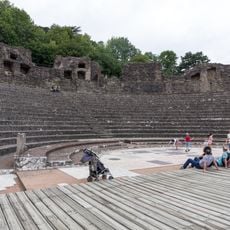
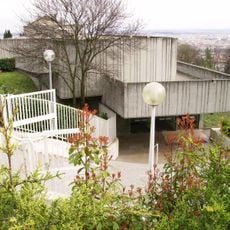
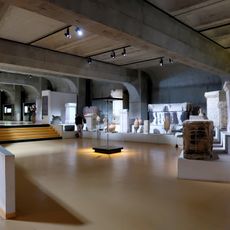
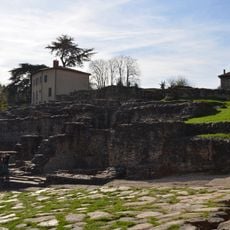
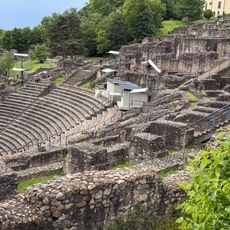
The Théâtre Gallo-Romain de Fourvière is an open-air Roman theater cut into the slope of the Fourvière hill in the 5th arrondissement of Lyon, with stone seating tiers arranged in a semicircle roughly 108 meters across. Next to it stands a smaller Odeon, a roofed concert theater from the same period, and both structures are open to visitors as part of the same archaeological site.
The theater was built during the reign of Emperor Augustus, when Lugdunum, now Lyon, served as the capital of the Roman province of Gallia Lugdunensis, and it was enlarged in the 2nd century to hold more people. After the decline of Roman power, the site was gradually abandoned and disappeared under layers of soil.
The theater takes its name from the Fourvière hill, whose name comes from the Latin "forum vetus", meaning the old forum, pointing to the heart of Roman Lyon. Today the stone tiers fill with audiences each summer during the Nuits de Fourvière festival, when performances take place under the open sky.
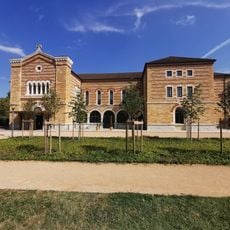
The site sits on a hillside and can be reached on foot from the top of Fourvière hill or by climbing up from the museum below, so wear sturdy shoes as the ancient stone steps can be uneven. In summer, some parts of the site may be closed off during festival preparations, so it is worth checking in advance what is accessible.
Beneath the ancient stone seating, the original Roman drainage channels built to manage water under the structure are still visible in places during a visit. These were uncovered during the early 20th century excavations that also brought the theater itself back to light after centuries underground.
The community of curious travelers
AroundUs brings together thousands of curated places, local tips, and hidden gems, enriched daily by 60,000 contributors worldwide.