Wielki Szyszak, Mountain peak in Karkonosze Mountains, Poland.
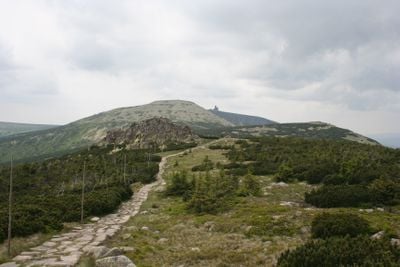
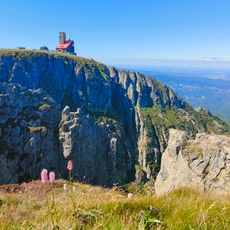
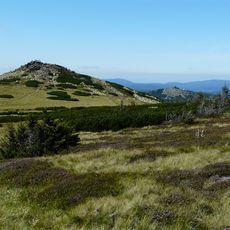
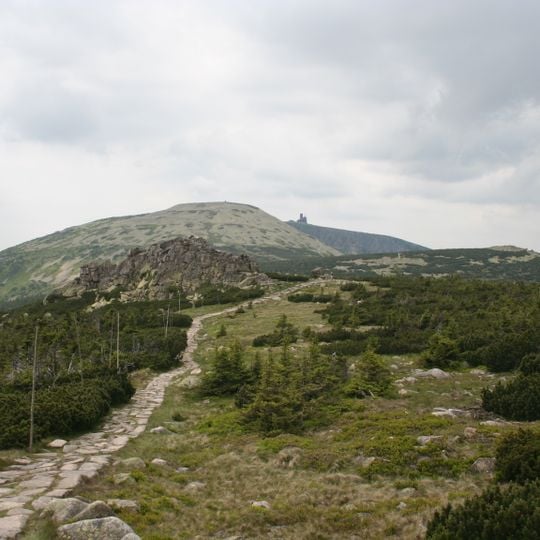
Wielki Szyszak (Hohes Rad, Vysoké kolo) is a 1,509 m granite peak on the Polish-Czech border, the highest granite summit of the Karkonosze and the fourth-highest in the Sudetes. Its upper slope is a pale green dome of grass and low vegetation, broken on the left by a mass of dark brown and grey rock outcrops below the summit; a small dark structure with a vertical profile stands on the skyline along the ridge to the right. The Polish north side drops in scree slopes and vertical rock walls up to 150 m high into the Śnieżne Kotły cirques.
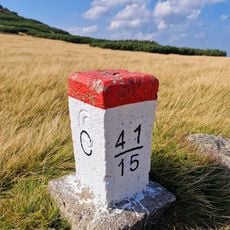
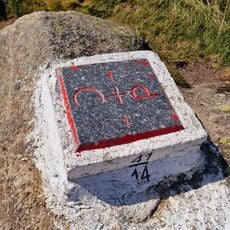
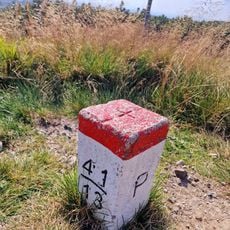
For centuries this peak formed a natural boundary between Silesia and Bohemia, serving as a reference point as different powers controlled the surrounding land. After World War II, the border between Poland and Czechoslovakia ran through here, and it remains the Polish-Czech border today.
The peak's Polish name was reassigned after World War II: the summit now called Wielki Szyszak was formerly Wielkie Koło, while the old name passed to the neighbouring Śmielec. Czech Vysoké kolo and German Hohes Rad stayed unchanged, so maps in three languages label the same border summit differently.
No marked trail reaches the summit itself: the main ridge route passes north below it, and the short branch once leading up from the path 300 m west of the top has been closed since 2009. Access is only possible in winter on the snow route, which bypasses the summit on the Czech side and is not open the rest of the year.
The summit carries a stone pyramid inscribed with the letter W and an eagle statue, a monument to German Emperor Wilhelm I erected in 1888, a few years after German unification. It stands right at the top, on the state border, and is visible from afar.
The community of curious travelers
AroundUs brings together thousands of curated places, local tips, and hidden gems, enriched daily by 94,035 contributors worldwide.