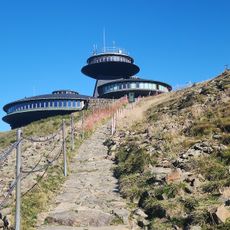
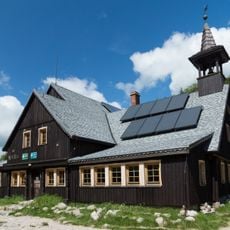
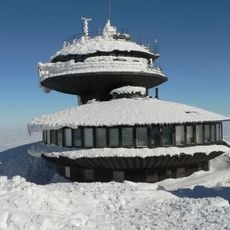
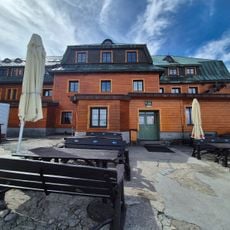
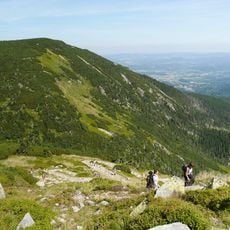
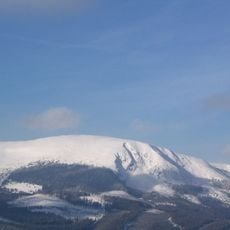
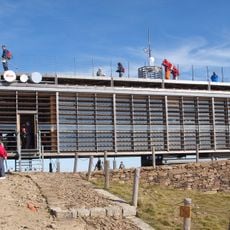
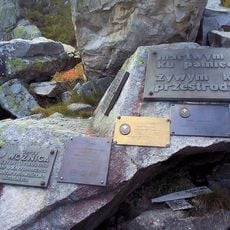
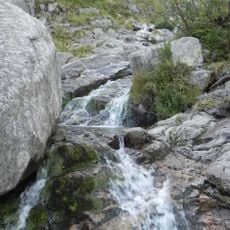
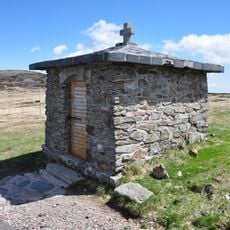
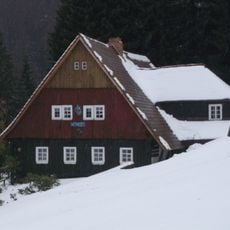
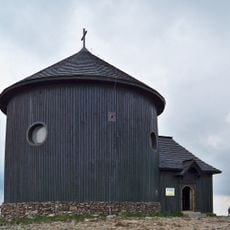
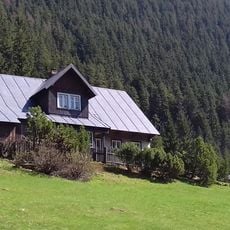
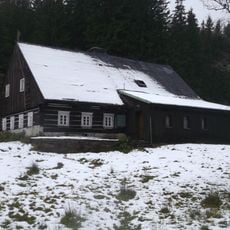
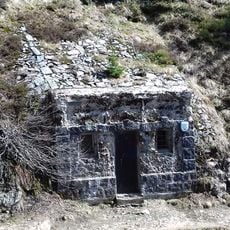
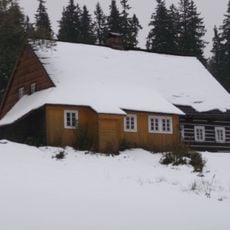
Równia pod Śnieżką, Tourism office at Równia pod Śnieżką plateau, Poland.
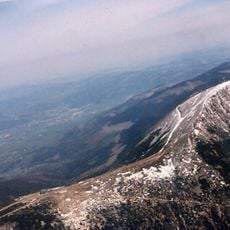
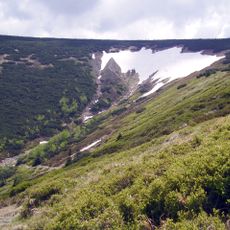
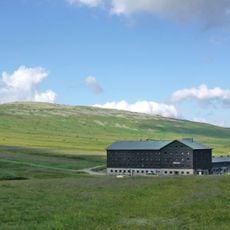
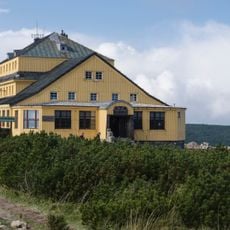
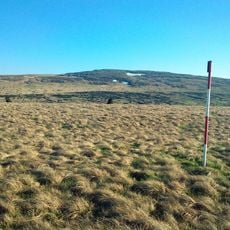
Równia pod Śnieżką is a subalpine plateau on the main ridge of the Giant Mountains, spanning about 9 km² at 1,350–1,450 m between the peaks of Śnieżka, Smogornia, Studniční hora and Luční hora. It is bounded by glacial cirques and cut by the Biała Łaba valley, with raised bogs up to 50 m across among dwarf pine. The Luční bouda mountain hut stands in its centre.
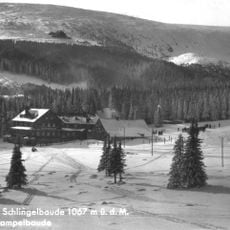
The Schlesierweg, an old trade road from Vrchlabí to Silesia, crossed the plateau from the mid-12th century, linking the salt deposits of the Bohemian Basin with Karpacz, Jelenia Góra and Kowary. Where it passed the source of the Bílé Labe on the adjacent White Meadow, the first mountain hut of the Giant Mountains, the Wiesenbaude, was built. In the 18th century several dozen head of cattle were grazed here, and during the Second World War German polar expeditions trained on the plateau.
The plateau is crossed by the Droga Przyjaźni Polsko-Czeskiej, the Polish-Czech Friendship Trail, and by the red-marked Główny Szlak Sudecki. On the meadow called Biała Łąka stands Luční bouda, the Wiesenbaude, one of the largest and oldest mountain huts in the Giant Mountains, rebuilt in its present form in the 1940s.
Visitors should prepare for changeable mountain weather and bring sturdy hiking shoes and protective clothing, as the terrain is exposed and often windy. The office offers maps and current information about trail conditions along with advice for planning safe day hikes.
In July 2023 the peat bog here was nominated as an auxiliary stratotype (SABS) for the Anthropocene epoch, studied by a team led by Barbara Fiałkiewicz-Kozieł for its high-resolution palaeoenvironmental record and technogenic particles such as aluminosilicate microspheres and mullite. The golden spike went to Crawford Lake in Canada.
The community of curious travelers
AroundUs brings together thousands of curated places, local tips, and hidden gems, enriched daily by 92,342 contributors worldwide.