Klášter augustiniánů kanovníků, Religious monastery in New Town, Prague, Czech Republic
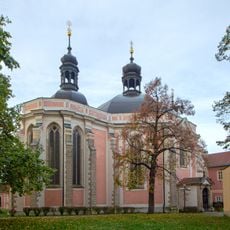
The former monastery of the Augustinian Canons at Karlov in Prague's New Town consists of a Gothic core rebuilt in Baroque style. Its church, dedicated to the Assumption of the Virgin Mary and St. Charles the Great, has a Gothic octagonal nave, a polygonal presbytery and a west tower, topped by three Baroque domed roofs with lanterns. The convent buildings are set back west of the church around a square cloister courtyard.
Charles IV founded the monastery by charter on 18 September 1350, confirmed by Pope Clement VI on 22 February 1352, and construction began in 1351. The church was consecrated in 1377 by Archbishop Jan Očko z Vlašimi in the presence of Charles IV and his son Wenceslas IV. Hussite raids in 1420 damaged and emptied the house, and Joseph II dissolved it in 1785.
The monastery now houses the Police Museum of the Czech Republic, where visitors can explore exhibits related to law enforcement history and border protection. This transformation connects the site's religious past with its contemporary educational mission.
The former monastery stands on a rocky ridge above the Nusle Valley in Prague's New Town, and the Police Museum of the Czech Republic occupies the convent buildings. Visitors enter from the north through a park-like courtyard framed by the new prelature, the old prelature and the church; the convent wings themselves are set back to the west, behind the church axis.
The church's roof was rebuilt in 1575 under Abbot Mikuláš Venc, after he told the ruler the monastery buildings were "now desolate"; the vaulting from that campaign survives. A lightning strike damaged the buildings in 1603, and the church was repaired and re-roofed while the convent was not.
The community of curious travelers
AroundUs brings together thousands of curated places, local tips, and hidden gems, enriched daily by 92,389 contributors worldwide.