Kaibab Trail Suspension Bridge, Suspension footbridge over the Colorado River in Grand Canyon National Park, United States
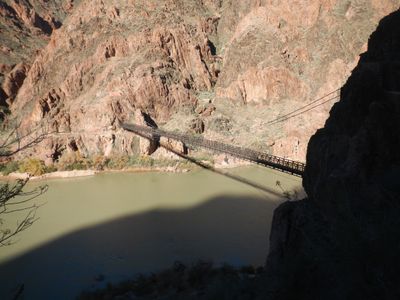
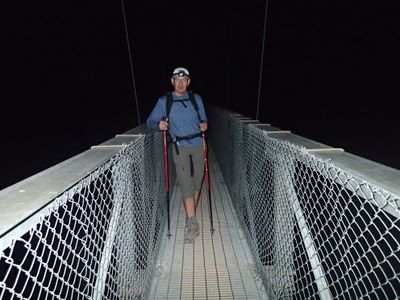
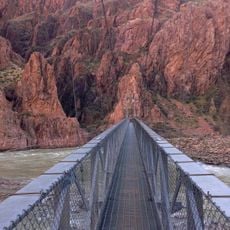
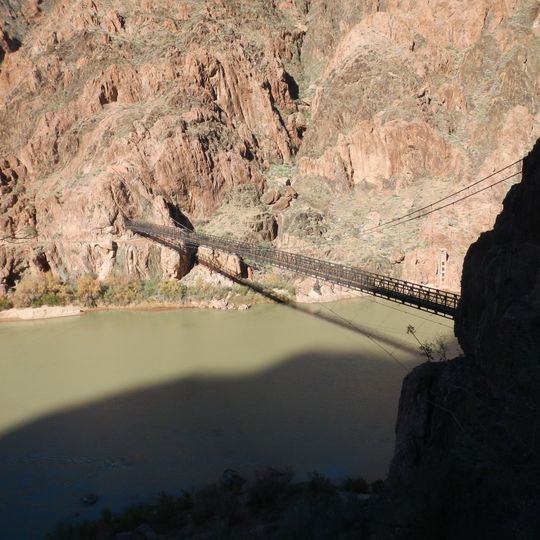
The Kaibab Trail Suspension Bridge, also called the Black Suspension Bridge, is a 440-foot (130 m) span over the Colorado River in Grand Canyon National Park. Its flat deck of pale wooden planks is edged by grey metal kerbs, with chain-link fencing rising on both sides and thin dark suspension cables slanting upward beyond. A small white sign is mounted near one end.
Before 1907, crossings of the Colorado River here were made by boat and cost many lives. Outdoorsman David Rust then built a privately operated cableway, a 6 by 10 foot steel cage used by Theodore Roosevelt in 1913. A 1920 suspension bridge proved too flexible, so Ward Webber designed and John Lawrence built the Black Bridge in 1928. Materials were carried down nine miles of trail; 42 Havasupai tribesmen walked single file carrying the one-ton, 550-foot suspension cables.
In 1928, 42 Havasupai tribesmen carried the one-ton, 550-foot suspension cables down nine miles of trail, walking single file, as part of the 122 tons of materials moved by humans and mules. The crossing now carries South Kaibab Trail hikers and the mule trains supplying Phantom Ranch.
The bridge is open to foot traffic and pack animals only, with frequent daily crossings. Plan your crossing for early morning or late afternoon when temperatures are lower and the trail is less crowded.
The bridge's 550-foot suspension cables were carried down nine miles of trail by 42 Havasupai tribesmen walking single file, along with 122 tons of other materials, since no motor vehicle could reach the site. The bridge was documented by the Historic American Engineering Record in 1984 and named a National Historic Civil Engineering Landmark on February 23, 2019.
The community of curious travelers
AroundUs brings together thousands of curated places, local tips, and hidden gems, enriched daily by 92,785 contributors worldwide.