Pulitzer Fountain, Fountain in Grand Army Plaza, Manhattan, United States.
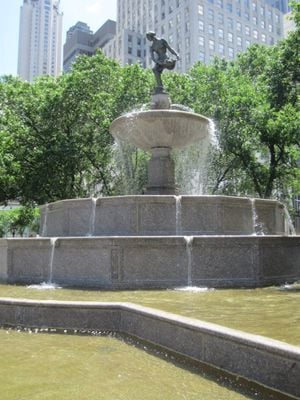
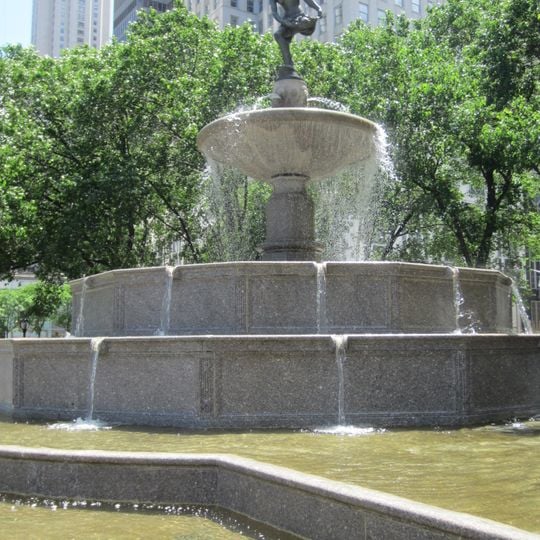
The Pulitzer Fountain is a nearly seven-metre granite fountain in the southern half of Grand Army Plaza. Water pours from spouts along the rim of a wide octagonal upper basin and falls from gaps between the vertical panels of a second octagonal tier into a broad pool. On a rounded pedestal at the top stands Karl Bitter's bronze Pomona, holding a basket from which thin streams of water fall.
Joseph Pulitzer died in 1911 leaving $50,000 for a fountain modelled on those of the Place de la Concorde. A 1913 competition, won by Carrère and Hastings, placed it in the southern half of Grand Army Plaza opposite the Sherman Monument. Construction began in 1915 and the fountain was dedicated in May 1916.
The bronze figure on top is Pomona, Roman goddess of fruit trees, modelled by Doris Doscher and cast in April 1916. Karl Bitter died in a car accident in 1915 after finishing the plaster cast, and Isidore Konti completed the work. The fountain was paid for by Joseph Pulitzer's $50,000 bequest, and its design echoes the fountains of the Place de la Concorde in Paris.
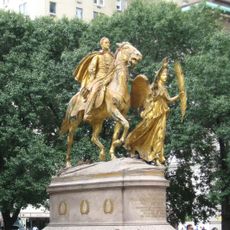
The fountain stands in the southern half of Grand Army Plaza, west of Fifth Avenue between 58th and 60th Streets, opposite the Sherman Monument. The plaza is paved and open, with the fountain reached on foot from the surrounding sidewalks. Subway construction delayed work on the plaza's northern portion in 1915, and the plaza remains a busy pedestrian crossing point.
The bronze Pomona was finished by Isidore Konti after Karl Bitter died in a car accident in 1915, having just completed the plaster cast. The model was Doris Doscher. The statue was cast in April 1916 and installed around May 1 with little or no ceremony.
The community of curious travelers
AroundUs brings together thousands of curated places, local tips, and hidden gems, enriched daily by 92,600 contributors worldwide.