Tolstoy Park, Historical residence in Montrose, Alabama, US.
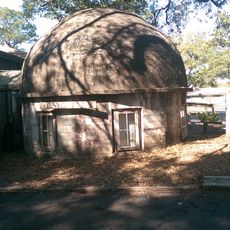
Tolstoy Park is a circular concrete hut about 14 feet in diameter, sunk 2 feet into the ground, with six top-hinged windows around the wall and two roof skylights that are now permanently closed. Henry Stuart poured each concrete block himself, completing the domed structure in under a year despite a September 1926 hurricane. A large oak stands beside it, and a real estate office parking lot surrounds the hut.
Henry Stuart, an Englishman who emigrated to the United States as a child, bought 10 acres outside Fairhope in 1923 and named the land Tolstoy Park after the Russian writer Leo Tolstoy. He began building the circular concrete hut in 1925, pouring each block himself, and finished in under a year despite a September 1926 hurricane. He left for Oregon in 1944 and died in 1946.
Stuart named the ten-acre estate after the Russian writer Leo Tolstoy, whose ideas on simple living he followed. He grew much of his own food and wove rugs on a loom brought from Idaho. A guestbook recorded visitors to the domed hut, among them the lawyer Clarence Darrow, who signed it six times.
The house is located in a rural area and is easiest to reach by car, as the surroundings lack public transportation options. The best time to visit is during daylight hours, when you can see the structure and windows clearly from outside.
Stuart personally manufactured each concrete block for the house, developing a system that could have inspired others. This hands-on approach was unusual for residential projects of his time and shows his experimental spirit.
The community of curious travelers
AroundUs brings together thousands of curated places, local tips, and hidden gems, enriched daily by 92,748 contributors worldwide.