Penn Incline, former funicular railway in Pittsburgh, US
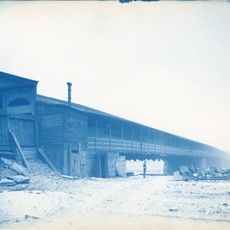
The Penn Incline was a funicular railroad that ran from 17th Street in Pittsburgh's Strip District up to Arcena (Ridgeway) Street in the Hill District. It measured 840 feet long with a vertical rise of 330 feet, and over 750 tons of bridge work carried two 10-foot-gauge tracks over the Pennsylvania Railroad yards, Bigelow Boulevard, and Liberty Avenue.
Service began in 1884 as part of Pittsburgh's expanding network of cable railways connecting hilltop residential areas with the industrial valleys below. It served as a crucial link for workers commuting between their homes and manufacturing facilities.
The upper landing hosted the Penn Incline Resort, a saloon and entertainment hall built alongside the incline to draw riders; The Pittsburg Dispatch called it "a favorite resort for the better class of Germans". After Pennsylvania's Brooks High License Law of 1888 ended liquor sales there, it declined and burned in 1892.
The incline no longer exists: it was dismantled between 1953 and 1956, so there is no station to board and no ride to take. Its route ran from 17th Street between Liberty and Penn avenues in the Strip District up to Arcena (Ridgeway) Street near Ledlie Street in the Hill District. City planners have discussed reviving it, and in 2020 mayor Bill Peduto proposed a gondola lift linking the Strip and Hill districts, possibly extending to Oakland, but nothing has been built.
The incline was designed by Samuel Diescher to hoist 20-ton coal loads, but that traffic never met expectations; produce merchants hauling goods from Strip District wholesale markets kept it running instead. In 1927 a stunt driver took a Willys-Overland Whippet up and down on a specially built plankway so the wheels would not lodge between the rail ties.
The community of curious travelers
AroundUs brings together thousands of curated places, local tips, and hidden gems, enriched daily by 92,725 contributors worldwide.