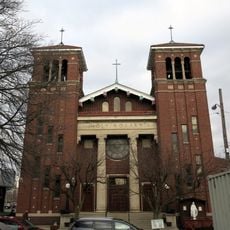
Holy Rosary-Danish Church Historic District, Historic district in Indianapolis, United States.
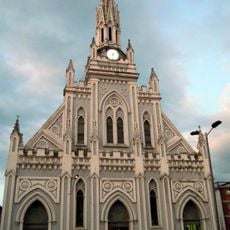
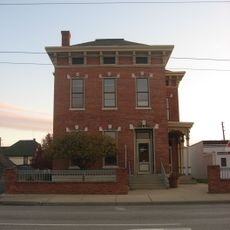
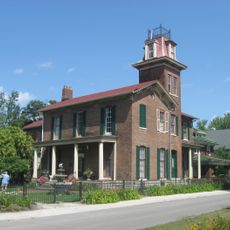
The Holy Rosary–Danish Church Historic District, also called Fletcher Place II, holds 183 contributing buildings in a mainly residential section of downtown Indianapolis. Development ran from about 1875 to 1930, with examples of Italianate, Gothic Revival, Tudor Revival and Renaissance Revival architecture. Named buildings include the John Kring House (c. 1872), Trinity Danish Evangelical Lutheran Church (1872), John Wands House (1857), Henry Homburg House (c. 1870), Samuel Keely House (c. 1870), Maria Wuensch Cottage (c. 1900) and Holy Rosary Catholic Church (1911–1925).
The district developed between about 1875 and 1930, with earlier houses such as the John Wands House (1857) and John Kring House (c. 1872) predating the period. Trinity Danish Evangelical Lutheran Church was built in 1872, and Holy Rosary Catholic Church was constructed between 1911 and 1925. The area became Indiana's largest Italian community by 1910, and the district was listed on the National Register of Historic Places in 1986.
The district's name pairs Holy Rosary Catholic Church (built 1911–1925) with Trinity Danish Evangelical Lutheran Church (1872), two congregations founded by different immigrant groups. The Danish church's name survives in the district designation even though the surrounding population changed; the Catholic parish, established by Italian immigrants, became the anchor of Indiana's largest Italian colony by 1910.
The neighborhood is located at the intersection of South East Street and South Stevens Street, bordered by Virginia Avenue and Interstate 65/70. Walking through the area allows you to explore the various house types and the two main churches from different vantage points.
Many of the older houses in this neighborhood were built by craftspeople who designed and constructed their own homes, resulting in a wide variety of personal architectural details. These individual features make each block distinctive and tell the story of individual families who lived here.
The community of curious travelers
AroundUs brings together thousands of curated places, local tips, and hidden gems, enriched daily by 92,776 contributors worldwide.