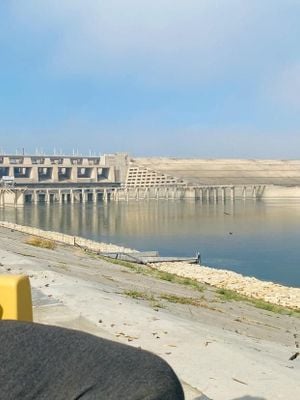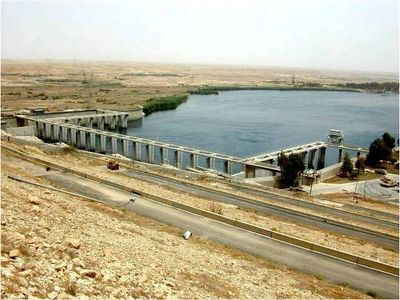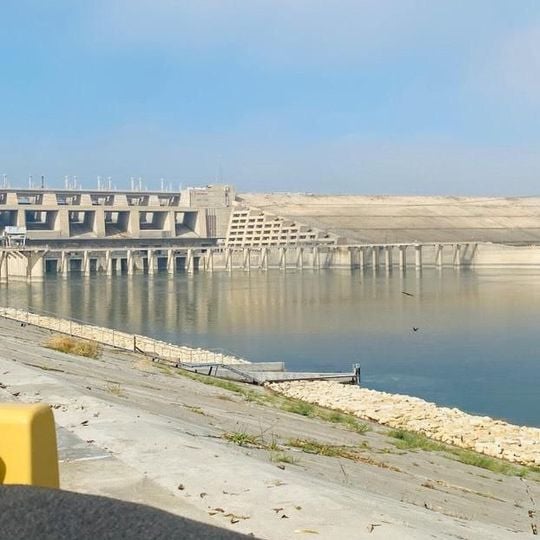
Haditha Dam, Earth-fill dam and hydroelectric station on the Euphrates River, Iraq.
Haditha Dam is a 9,064-metre-long, 57-metre-high earth-fill dam on the Euphrates north of Haditha, Iraq. Its core is an asphaltic concrete cutoff wall of dolomite, sand and gravel, faced with a reinforced concrete slab upstream and rock revetment downstream. The power station sits in a former secondary channel 3,310 metres from the southern edge, where six Kaplan turbines share a hydrocombine structure with the spillway.
Construction of this installation began in the late 1970s through cooperation between Soviet and Iraqi authorities. The project reached completion after a decade and became a major infrastructure asset for power generation.
The reservoir flooded the archaeological site of Usiyeh, on the right bank of the Euphrates between Haditha and Anah, and also submerged ancient Anah with its prized minaret; only modern Anah remains. Japanese archaeologists excavated Usiyeh in 1982–1983, finding a multi-room underground structure, a staircase and lion terracotta statues dated to 1800–1700 BC.
The site sits along a section of river with year-round water flow, which ensures stable operating conditions. Visitors should know that the facility operates in an arid climate and access to industrial installations is often limited.
On 1 April 2003, US Army Rangers seized the dam to keep it from being destroyed, since its loss would have hit the national grid and flooded the valley downstream. Marines and a small Azerbaijani detachment were later stationed there. In 2004 a US Army Corps of Engineers turbine overhaul brought the plant to full capacity for the first time since 1990.
The community of curious travelers
AroundUs brings together thousands of curated places, local tips, and hidden gems, enriched daily by 92,588 contributors worldwide.